

ERC Advanced Grant Awarded to MATH+ Member Cecilia Clementi (FU Berlin)
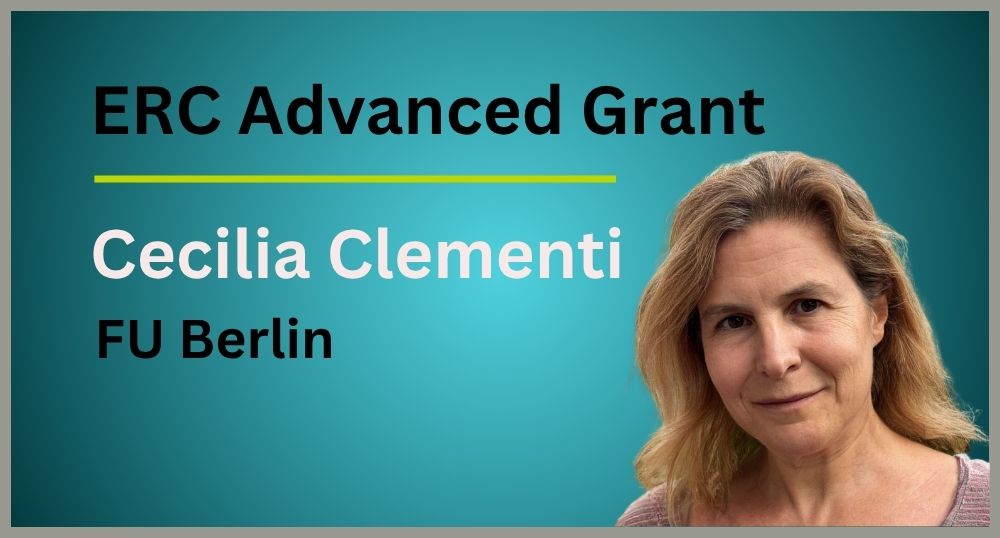
MATH+ member and physicist Cecilia Clementi, Einstein Professor at Freie Universität Berlin, has been awarded an ERC Advanced Grant by the European Research Council (ERC) for her project ProDyGe—“Protein Dynamics with Generalized Machine-Learned Potentials.” The grant provides approximately €3.037 million over five years to advance biomolecular dynamics simulations. ERC Advanced Grants support outstanding researchers with a strong track record of research excellence who pursue ambitious, groundbreaking projects at the frontiers of their fields.
Cecilia Clementi is Professor of Theoretical and Computational Biophysics at Freie Universität Berlin. Her research combines methods from statistical physics, computational biophysics, and machine learning to deepen understanding of complex biological processes on a molecular scale.
Commenting on the award, Clementi said: “Our goal with ProDyGe is to make biomolecular processes that were previously difficult or nearly impossible to simulate predictable, regardless of size and across longer timescales. If we succeed, we will be much better equipped to understand complex biological mechanisms and open up new methods of investigating the effects of different medications or how large molecular machines function. The ERC Advanced Grant gives us the opportunity to pursue a totally novel approach that lies at the intersection of physics, biology, and artificial intelligence.”
Reflecting on the project’s connection to MATH+, she added “The results we obtained in collaboration with Professor Frank Noé through previous MATH+ projects provided important preliminary results for my ERC proposal.”
Project ProDyGe: New Methods for Simulating Biological Molecules
Proteins and other biomolecules are considered the building blocks of life. Their function depends not only on their structure but also on their protein dynamics and interactions. While recent years have brought major breakthroughs in protein sequencing and structure prediction, accurately capturing biomolecular dynamics remains one of the central challenges in molecular biology.
The ERC-funded project ProDyGe addresses this challenge by developing a broadly applicable machine-learning framework for simulating large biomolecular systems more efficiently without compromising accuracy. These simulations are expected to provide insights into processes central to health and disease, including how protein folding, pharmaceutical substance binding, and large molecular complexes work.
Clementi’s research group will develop a new physics-based machine-learning approach that combines information from high-resolution simulations with experimental data to predict structural changes, free-energy landscapes, and binding affinities across a broad range of biological systems.
Connection to MATH+
Within MATH+, Cecilia Clementi contributes to interdisciplinary research in the Application Area “Health,” where researchers develop mathematical and computational approaches to address challenges in medicine and the life sciences. Her ERC project ProDyGe closely aligns with this mission by advancing data-driven and physics-informed methods for modeling biomolecular processes.
By integrating mathematical modeling, machine learning, and multiscale simulation approaches, ProDyGe strengthens interdisciplinary research at the interface of mathematics, biology, and health sciences. The project contributes to the broader goal of generating quantitative insights into complex biological systems and supporting future developments in biomedical research and therapeutic discovery.
Together with MATH+ member Frank Noé (FU Berlin), she is involved in the MATH+ project “Learning Fast and Accurate Long-Ranged Interactions in Multiscale Molecular Systems,” within the Health Application Area. This project develops and implements a systematic algorithmic framework to learning fast and accurate long-ranged interactions in machine-learned force fields (MLFFs), which serve as efficient emulators of materials and molecular systems at quantum-level chemical accuracy and are becoming a cornerstone of materials and drug design.
Recently, MATH+ approved funding for another upcoming joint project by Frank Noé and Cecilia Clementi within the Health Application Area, titled “Equilibrium Generative Force Fields for Molecular Systems.” The project aims to develop a mathematical and machine-learning (ML) framework for a transferable machine-learned force field that can simultaneously generate its equilibrium distribution through a denoising diffusion model. The method combines recent breakthroughs in machine learning for electronic structure and the sampling problem, and may enable new applications in drug discovery and materials design.
About Cecilia Clementi
Cecilia Clementi is an Italian-American scientist and an Einstein Professor of Theoretical and Computational Biophysics at Freie Universität Berlin, where she has been a faculty member since 2020 and has strengthened connections between experimental biophysics and applied mathematics. Before joining Freie Universität Berlin, she was a professor at Rice University in Houston, Texas (U.S.), and co-director of the Molecular Sciences Software Institute, funded by the U.S. National Science Foundation. Her research focuses on the simulation of complex biophysical processes across different scales and the development of data-driven multiscale modeling approaches for biomolecular systems.
About the ERC
Established by the European Union in 2007 and governed by an independent Scientific Council, the European Research Council (ERC) is Europe’s leading funding organization for frontier research. The ERC supports outstanding researchers of all nationalities and career stages through competitive funding programs that support projects conducted across Europe. The four core main funding schemes are Starting Grants, Consolidator Grants, Advanced Grants, and Synergy Grants.
LINKS:
- Press release on the ERC Grant from Freie Universität Berlin (June 2026)
- ERC Advanced Grants 2026
- Research group of Cecilia Clementi
- Publication in Nature Chemistry: “Navigating protein landscapes with a machine-learned transferable coarse-grained model”(2025)
- Press release from Freie Universität Berlin (July 18, 2025)
- MATH+ projects of Cecilia Clementi and Frank Noé:
- Project “Data-Driven Modeling from Atoms to Cells” (2022–2025), jointly led by Cecilia Clementi, Frank Noé, and Christof Schütte, within the Health Application Area “Mechanisms of Life”
- Project “Coarse-Graining Electrons in Quantum Systems” (January 2024–December 2025), within the Health Application Area “Nano and Quantum Technologies”
- Project “Learning Fast and Accurate Long-Ranged Interactions in Multiscale Molecular Systems” (July 2026–June 2028), within the Health-2 Application Area