

Project
AA-Ener-3
Next Generation Perovskite Photovoltaic Devices
Project Heads
Christiane Becker, Sven Burger, Andrea Walther
Project Members
Anna Barkova
Project Duration
01.01.2026 − 31.12.2028
Located at
ZIB
Short Description
Solar cells convert incoming sunlight into electrical energy. This process is governed by electromagnetic wave propagation in layered materials. Photovoltaics (PV) installations reached a global capacity of two terawatt by November 2024, at high rates of growth and cost reduction. However, for further growth of PV, which is necessary for mitigation of climate change, research and technological advances are indispensible.
Goals of the Project: The goal is the numerical simulation and optimization of next generation PV cells. This includes development and application of methods for simulating luminescent coupling, of methods for optimization of nonsmooth optimization problems with parameter derivative information to be used for nanostructure optimization in tandem solar cells, and of artificial intelligence (AI) based methods for fast optimization of color impression of multi-layer coated solar cell stacks.
At HZB (PI Christiane Becker and collaborating groups at HZB), perovskite PV devices will be realized experimentally, based on numerical designs obtained with the data-based optimization methods developed in this project.
Selected Pictures
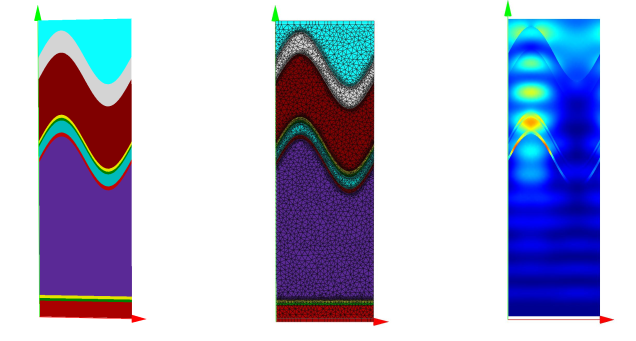
Calculating absorption
Light absorption in each layer of solar cell is computed by solving time-harmonic Maxwell’s Equations. Maxwell’s equations must be solved
for each wavelength of visible light. Maxwell’s equations are solved using JCMsuite, a finite-element solver.
Figure: Nanostructured tandem solar cell model, Finite Element Method mesh and simulated electric field for λ = 861 nm.
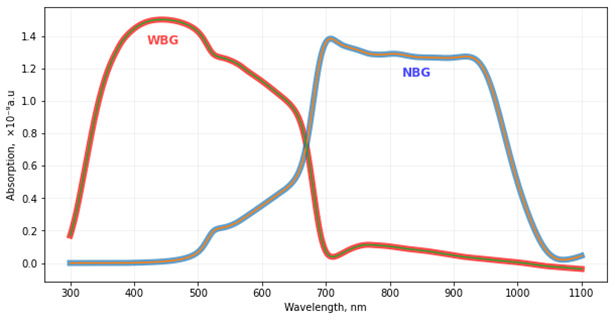
Spectral absorption in the two active layers of a tandem solar cell
Red WBG preovskite; blue: NBG perovskite.