

Project
AA-Ener-1
Multiscale Cavities for Photonic Quantum Technologies
Project Heads
Felix Binkowski, Sven Burger, Stephan Reitzenstein
Project Members
Fridtjof Betz
Project Duration
01.01.2026 − 31.12.2028
Located at
ZIB
Short Description
We aim to develop and investigate numerical methods for simulating photonic cavities for quantum technology applications. In particular, we plan to research methods based on highly efficient rational approximation of the photonic response in the complex frequency plane. We will develop innovative frameworks based on the Adaptive Antoulas-Anderson (AAA) algorithm. These methods will allow to investigate and optimize photonic cavities with multiscale geometries, such as nanobeam cavities including 2D quantum materials. These are building blocks of quantum key distribution setups and other integrated quantum devices.
Project Webpages
Related Publications
- High Purcell enhancement in all-TMDC nanobeam resonator designs with active monolayers for nanolasers, Felix Binkowski, Aris Koulas-Simos, Fridtjof Betz, Matthias Plock, Ivan Sekulic, Phillip Manley, Martin Hammerschmidt, Philipp-Immanuel Schneider, Lin Zschiedrich, Battulga Munkhbat, Stephan Reitzenstein, Sven Burger, Phys. Rev. B 112, 235410 (2025)
- Pole-Expansion of the T-Matrix Based on a Matrix-Valued AAA-Algorithm, Jan David Fischbach, Fridtjof Betz, Lukas Rebholz, Puneet Garg, Kristina Frizyuk, Felix Binkowski, Sven Burger, Martin Hammerschmidt, Carsten Rockstuhl, arXiv:2602.18414 (2026)
Related Pictures
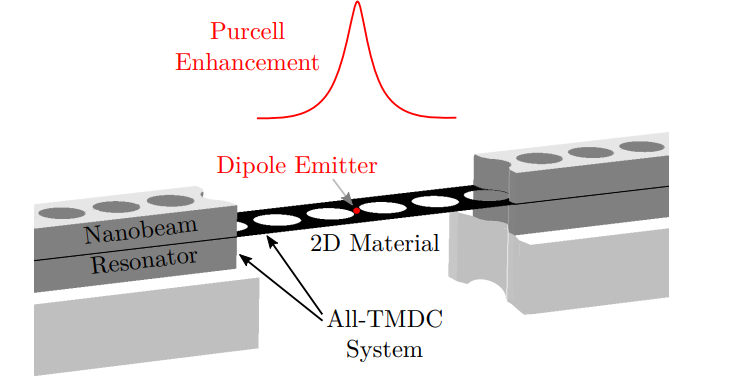
Fig. 1. Purcell enhancement in an all-TMDC nanobeam resonator. The 2D material, which is a TMDC monolayer, acts as an active layer. The emission process can be modeled by a dipole emitter that couples with the resonance modes of the system.
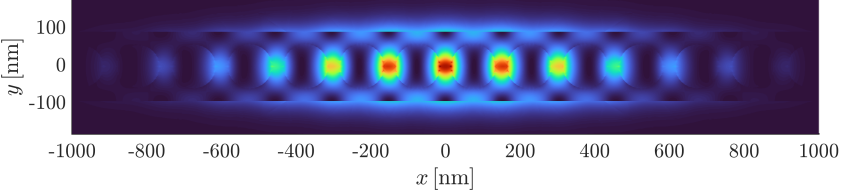
Fig. 1. Electric field intensity of the dominant resonance mode of an all-TMDC nanobeam resonator. The system is optimized such that the maximum intensity is located at the center of the resonator, which is the location of the considered dipole emitter.