

Project
AA4-13
Equilibria for Distributed Multi-Modal Energy Systems under Uncertainty
Project Heads
Pavel Dvurechenskii, Caroline Geiersbach (until 09/24), Michael Hintermüller, Aswin Kannan
Project Members
Felix Sauer
Project Duration
01.04.2023 − 31.03.2026
Located at
WIAS
Short Description
Motivated by decarbonization goals, this project concerns the modeling and mathematical analysis of multi-modal energy markets on the intraday scale, which are organized in a distributed fashion. Uncertainties arising from physical quantities and short-term fluctuations in energy output are incorporated.
Additional Information
On the mathematical side, we study physics-based multiagent problems that take a form of stochastic generalized Nash equilibrium problems (SGNEPs) in infinite dimensions. In lieu of natural gas markets, literature has focused on parts or stylized versions of these problems, but have not been complete. Works related to game theoretic electricity markets on the other hand have not focused much on PDE type constraints or infinite dimensions. Study of such comprehensive and coupled systems is the major objective of this research.
The project is expected to advance the development of distributed models and methods in the context of multi-modal energy systems. From an application perspective, the goal is to model the intraday behavior of a distributed electricity market that is coupled to a hydrogen gas network. The mathematical goals include the rigorous analysis of such systems, including incorporating uncertainties and showing existence of equilibria for the distributed system in the function space setting. Additionally, novel mesh-independent distributed methods will be developed to compute equilibria.
We develop in [4] a novel model of a coupled hydrogen and electricity market on the intraday time scale, where hydrogen gas is used as a storage device for the electric grid. Electricity is produced by renewable energy sources or by extracting hydrogen from a pipeline that is shared by non-cooperative agents. The resulting model is a generalized Nash equilibrium problem. Under certain mild assumptions, we prove that an equilibrium exists.
Related Publications
- P. Dvurechensky, A. Ebner, J. C. Schnebel, S. Shtern, and M. Staudigl, Stochastic variance reduced extragradient methods for solving hierarchical variational inequalities, https://arxiv.org/abs/2602.13510, 2026
- P. Dvurechensky, M. Marschner, S. Shtern, and M. Staudigl, Extragradient methods with complexity guarantees for hierarchical variational inequalities, https://arxiv.org/abs/2512.20791, 2025.
- E. Tevruez, A. Kannan, Adaptive Methods for Multiobjective Unit Commitment, Under Review, https://arxiv.org/abs/2501.07128, 2025.
- P. Dvurechensky, C. Geiersbach, M. Hintermüller, A. Kannan, S. Kater, G. Zöttl, A Cournot-Nash Model for a Coupled Hydrogen and Electricity Market, Energy Systems (accepted), https://arxiv.org/abs/2410.20534, 2026.
- A. Rogozin, A. Beznosikov, D. Dvinskikh, D. Kovalev, P. Dvurechensky, and A. Gasnikov, Decentralized saddle point problems via non-Euclidean mirror prox, Optimization Methods and Software, 40(5):1127–1152, 2025.
- P. Dvurechensky and J.-J. Zhu. Analysis of Kernel Mirror Prox for Measure Optimization. In Proceedings of The 27th International Conference on Artificial Intelligence and Statistics. Ed. by S. Dasgupta, S. Mandt, and Y. Li. Vol. 238. Proceedings of Machine Learning Research. PMLR, 2024, pp. 2350–2358.
- C. Geiersbach, R. Henrion, and P. Pérez-Aros, Numerical solution of an optimal control problem with probabilistic and almost sure state constraints. Journal of Optimization Theory and Applications, 204:7, 2025.
- C. Geiersbach and R. Henrion, Optimality conditions in control problems with random state constraints in probabilistic or almost-sure form. Mathematics of Operations Research, 50(3):1585-2432, 2025.
- C. Geiersbach and M. Hintermüller, Optimality conditions and Moreau–Yosida regularization for almost sure state constraints, ESAIM: Control, Optimisation and Calculus of Variations, Volume 28, 2022.
- V. Grimm, M. Hintermüller, O. Huber, L. Schewe, M. Schmidt, and G. Zöttl, A PDE-constrained generalized Nash equilibrium approach for modeling gas markets with transport, Preprint, TRR 154, 2021.
- P. Dvurechensky, D. Dvinskikh, A. Gasnikov, C. Uribe, and A. Nedich, Decentralize and randomize: Faster algorithm for Wasserstein barycenters, In NeurIPS 2018, pages 10783–10793, 2018.
- A. Kannan, U. Shanbhag, and H. Kim, Addressing supply-side risk in uncertain power markets: Stochastic Nash models, scalable algorithms and error analysis. Optimization Methods and Software, 28(5):1095–1138, 2013.
Related Pictures

An Example of a Joint Network.
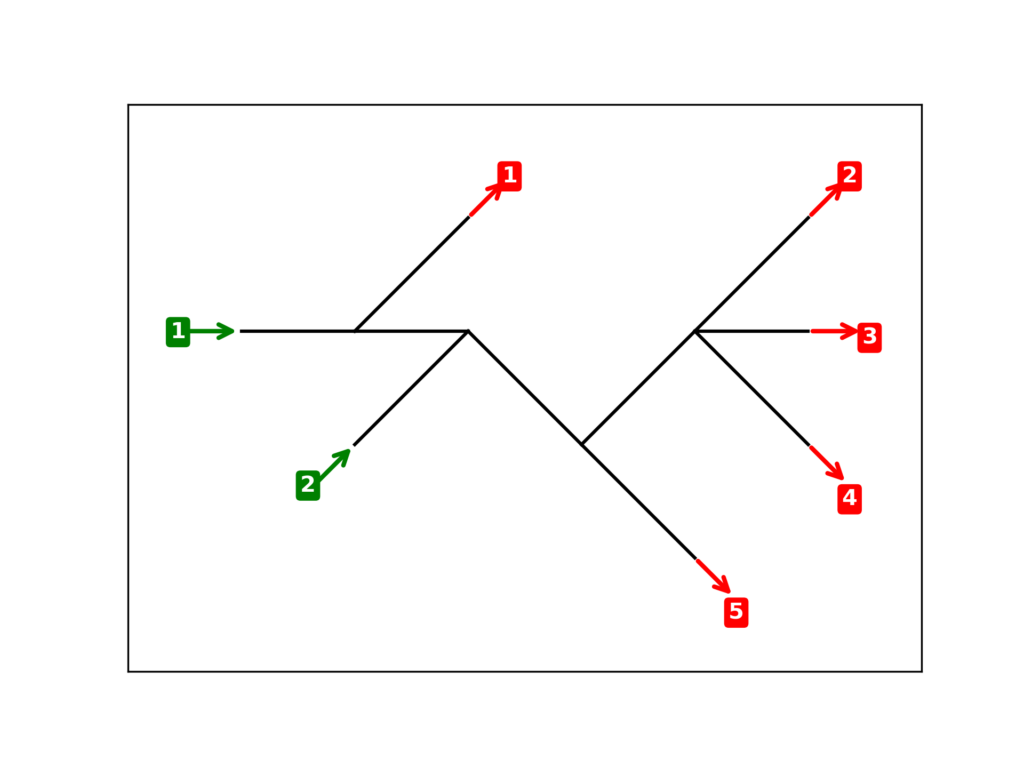
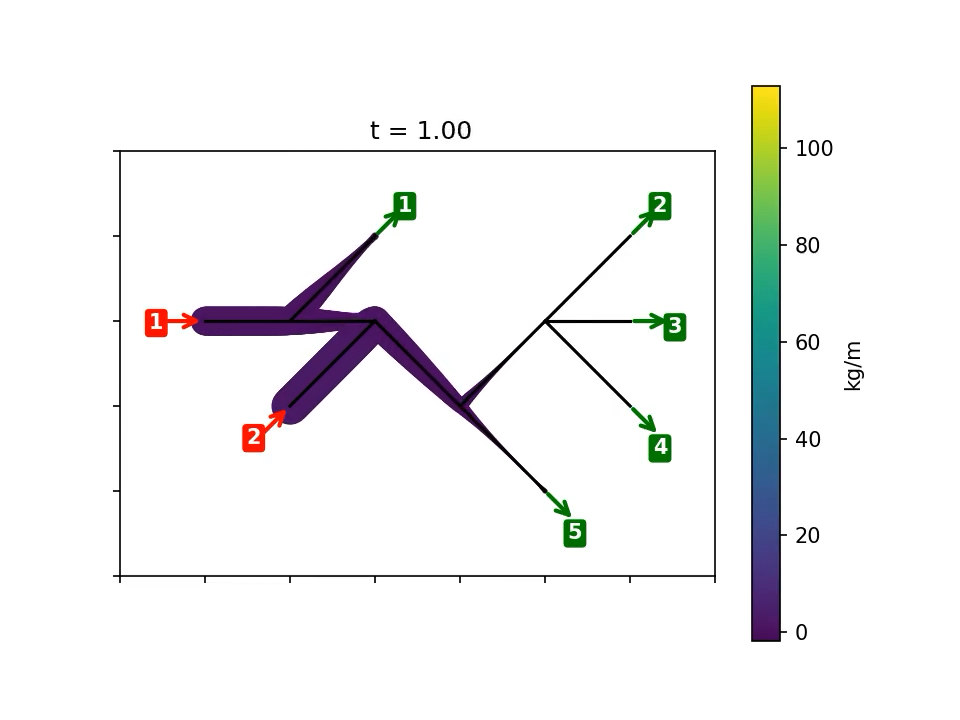
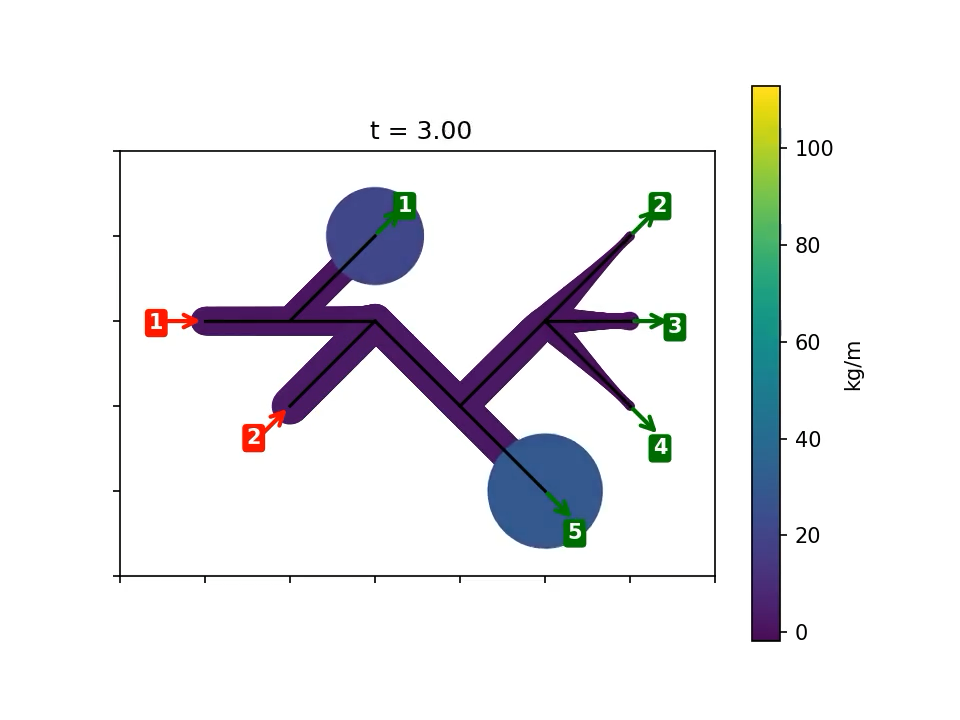
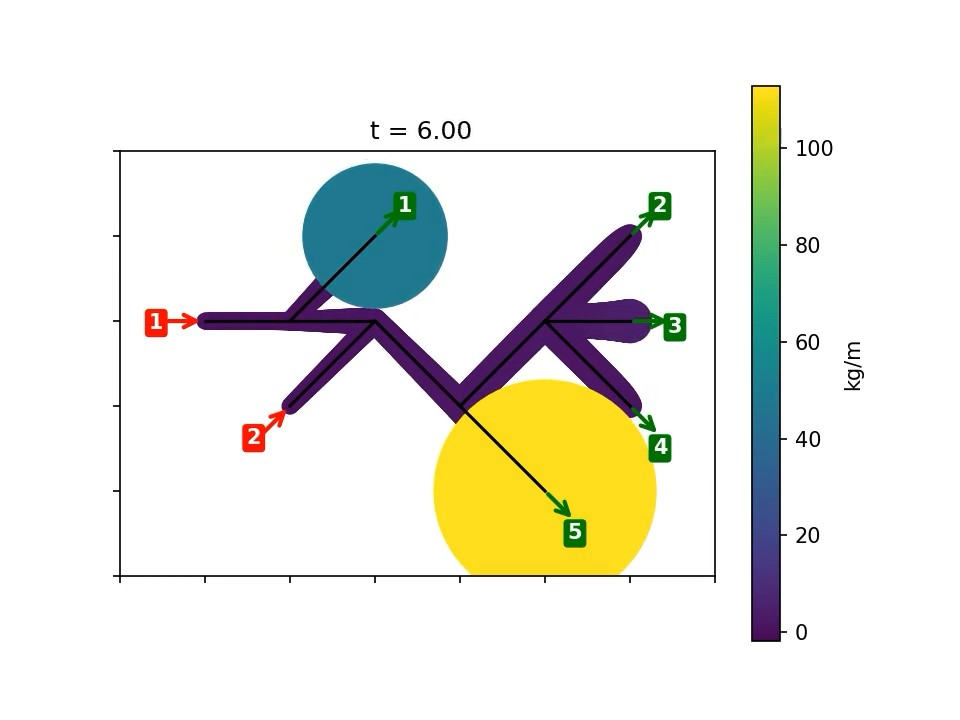
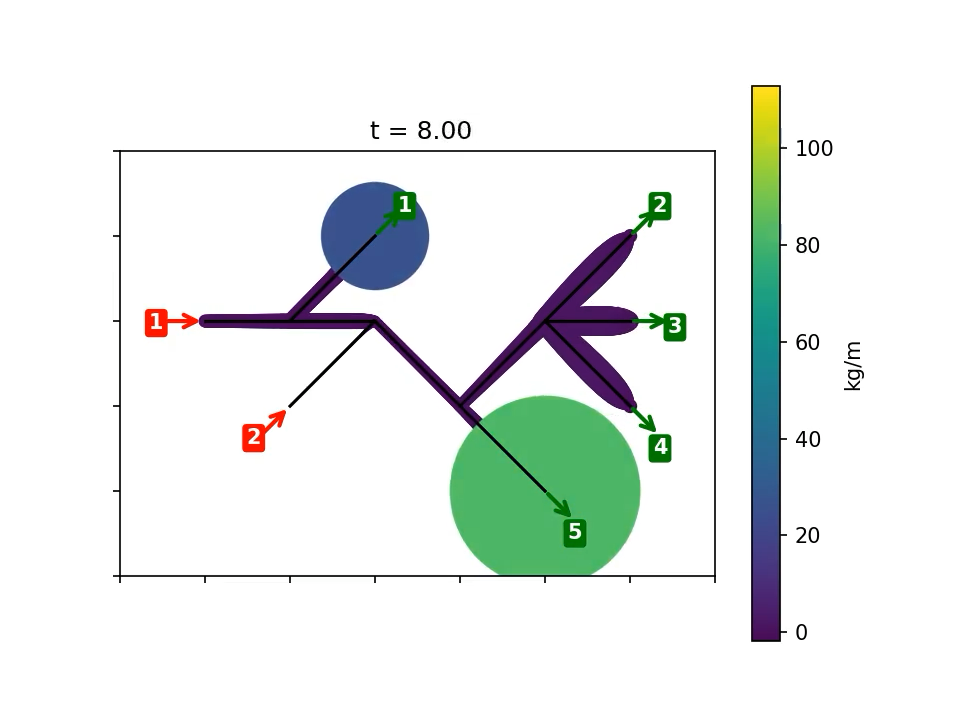
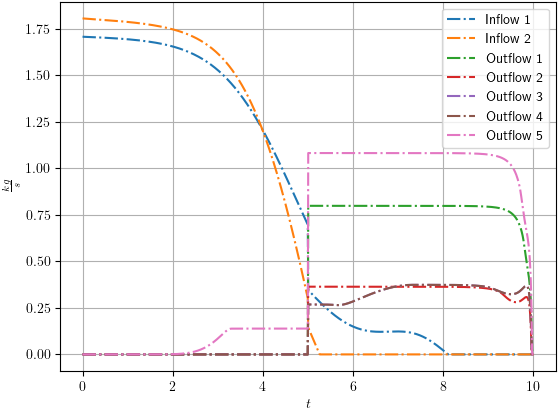
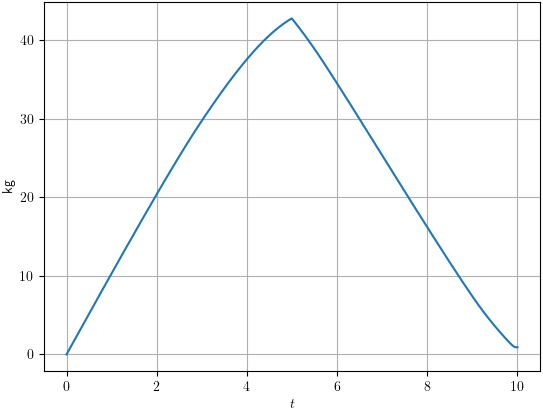
Example of market dynamics and line-packing: A simple network with two inflow nodes (green) and five outflow nodes (red). Agents acting on the boundary nodes control the flow of a commodity through the network. Market parameters cause the agents to produce in the first half, use the network as a storage device (line-packing), and sell in the second half of the period to optimize their profit.