

Project
AA-Mobil-3
Dynamic Traffic Equilibria in Network Games and Simulation
Project Heads
Kai Nagel, Martin Skutella
Project Members
Theresa Ziemke
Project Duration
01.11.2025 – 31.10.2028
Located at
TU Berlin
Description
This interdisciplinary project aims to advance research at the intersection of network flows, algorithmic game theory, and traffic simulation. The recently established connection between the mathematical model of Nash flows over time and the large-scale agent-based transport simulation tool MATSim will be used to advance our understanding of dynamic traffic equilibria. Theoretical insights will be translated into clear guidelines for users and decision-makers to correctly configure and utilize the simulation, enabling them to identify advanced mobility solutions.
Project Webpages
Related Publications
- T. Ziemke, L. Sering, L. Vargas Koch, M. Zimmer, K. Nagel, & M. Skutella, Flows Over Time as Continuous Limits of Packet-Based Network Simulations. Transportation Research Procedia, 2021. doi:10.1016/j.trpro.2021.01.014.
- L. Sering, L. Vargas Koch & T. Ziemke, Convergence of a Packet Routing Model to Flows Over Time. Mathematics of Operations Resarch, 2022. doi:10.1287/moor.2022.1318
- T. Ziemke, L. Sering & K. Nagel, Spillback Changes the Long-Term Behavior of Dynamic Equilibria in Fluid Queuing Networks. 23rd Symposium on Algorithmic Approaches for Transportation Modelling, Optimization, and Systems (ATMOS 2023). doi:10.4230/OASIcs.ATMOS.2023.11
Selected Pictures

Discrete vs. continuous flow dynamics
Flow dynamics in MATSim (left) compared with the continuous flow-over-time model (right). The numbers denote the flow capacities.
Picture reference: [1]
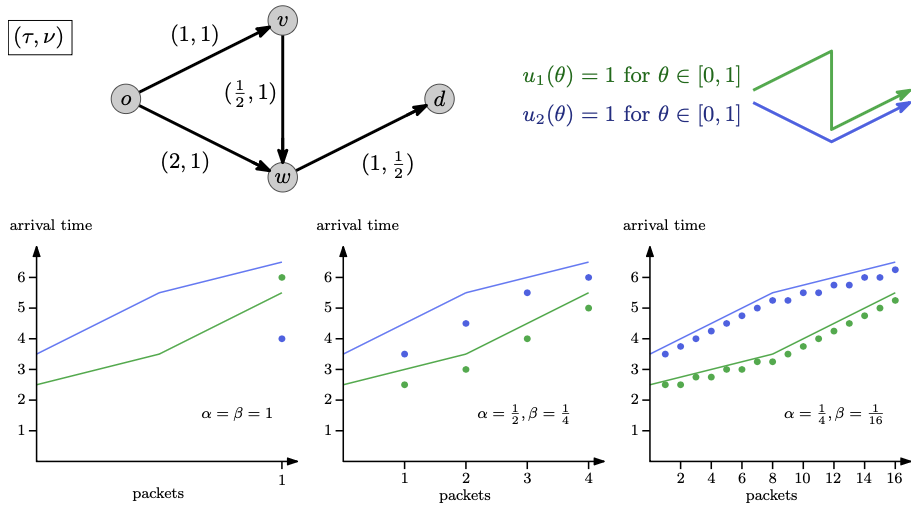
Discrete to continuous flow convergence
The convergence of a discrete packet routing model toward the continuous flow-over-time model under increasingly refined vehicle packet sizes and time steps has been proven mathematically [2]. The figure illustrates this convergence using an example network with two simultaneously active commodities. The labels on the network edges denote free-speed travel times and flow capacities. The green commodity sends flow along the zigzag path, while the blue commodity uses the lower path. The plotted arrival times for both discrete vehicle packets and continuous flow show how increasingly refined discrete packets approach the continuous solution.
Picture reference: [2]
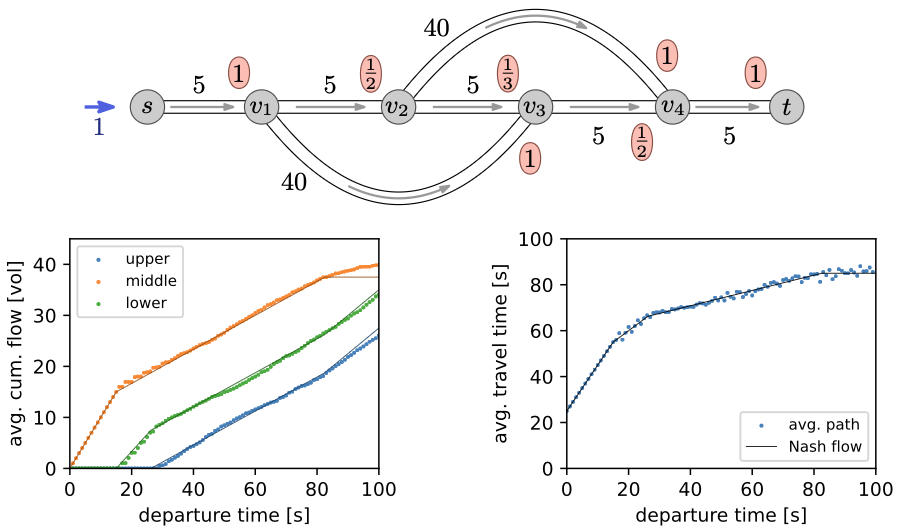
Simulation experiments: stochastic discrete vs. exact continuous equilibria
Simulation experiments suggest that, even without refining discrete vehicle packet sizes or time steps, stochastic user equilibria in the discrete MATSim model approximate the exact Nash flow-over-time equilibrium when averaged over multiple simulation runs with different random seeds. The figure illustrates this phenomenon using an example network, shown at the top, in which a travel demand of one unit of flow volume per second is routed from left to right and can choose among three possible routes. The labels on the network edges denote free-flow travel times in seconds and flow capacities. The lower part of the figure shows the corresponding cumulative flow volume and travel time curves for MATSim simulations at a coarse discretization level, averaged over multiple runs with different random seeds, together with the exact continuous Nash flow-over-time solution. While individual simulation runs can deviate substantially from the continuous equilibrium at this coarse refinement level, the averaged curves align remarkably well with the exact continuous solution.
Picture reference: [1]
Please insert any kind of pictures (photos, diagramms, simulations, graphics) related to the project in the above right field (Image with Text), by choosing the green plus image on top of the text editor. (You will be directed to the media library where you can add new files.)
(We need pictures for a lot of purposes in different contexts, like posters, scientific reports, flyers, website,…
Please upload pictures that might be just nice to look at, illustrate, explain or summarize your work.)
As Title in the above form please add a copyright.
And please give a short description of the picture and the context in the above textbox.
Don’t forget to press the “Save changes” button at the bottom of the box.
If you want to add more pictures, please use the “clone”-button at the right top of the above grey box.