

Project
AA-Tech-4
DOC-TWIN: Duality-Based Error Control for Optimal Control Problems in Digital-Twin-Based Structural Health Monitoring
Project Heads
Michael Hintermüller, Alex N. Kaltenbach, Harbir Antil (associated)
Project Members
N.N.
Project Duration
01.01.2027 − 31.12.2028
Located at
WIAS
Description
Better decisions through more reliable predictions
DOC-TWIN aims to improve decision-making in structural safety by making digital-twin predictions more reliable through explicit, duality-based a posteriori error control. The project connects sensor-informed PDE models with computable numerical error certificates, so that decisions about inspection, operating conditions, and maintenance can draw on a clearer assessment of the accuracy of the underlying computations.
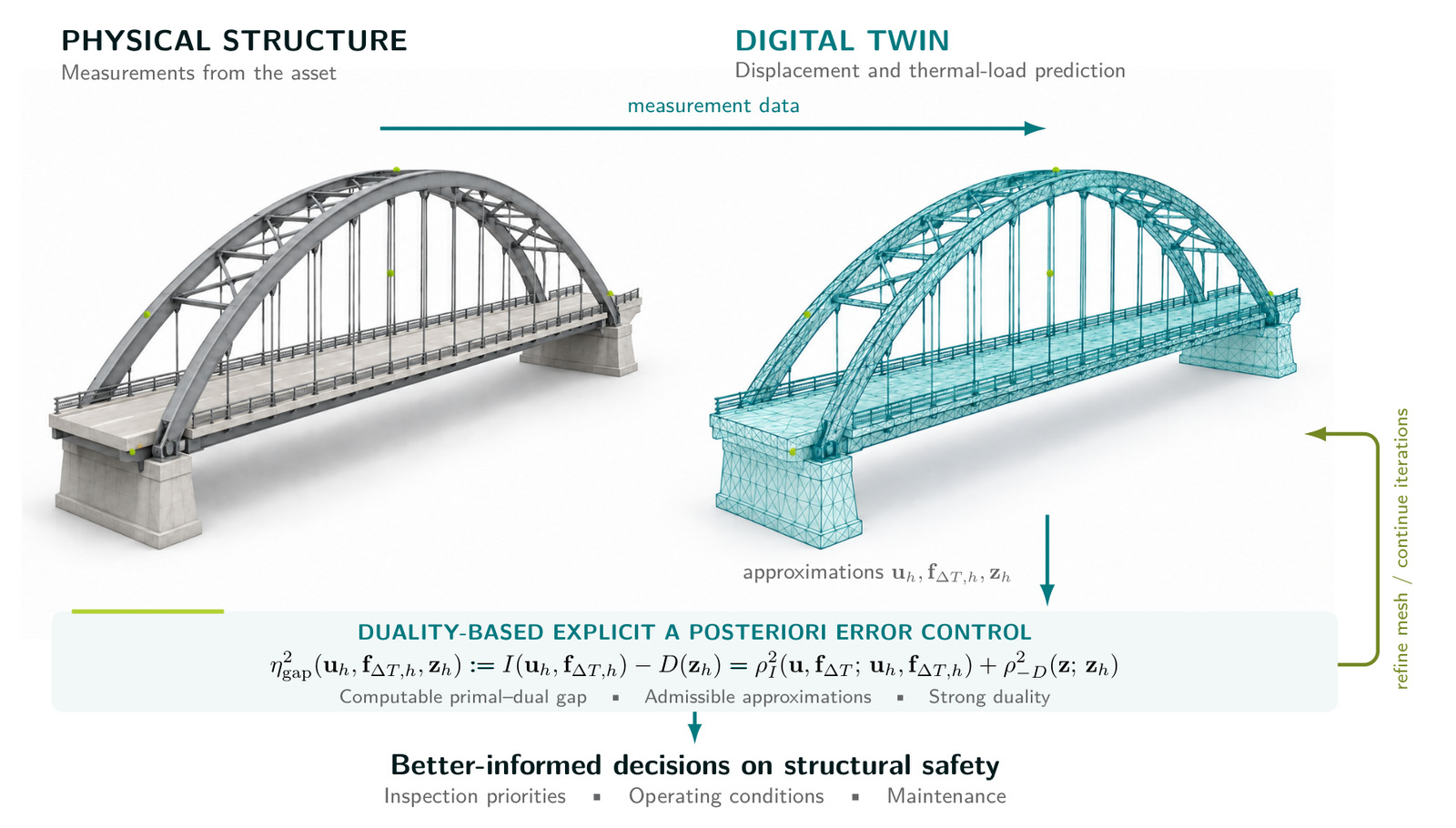
Bridges, dams, and tunnels are essential to everyday life, yet much of this infrastructure is aging. The Carola Bridge collapse in Dresden in 2024 highlighted the consequences of hidden deterioration. A digital twin links the behaviour of a particular structure to a mathematical model that is updated with measurements. It can help infer hidden loads and assess structural response. For these predictions to support safety-related decisions, their numerical accuracy must be quantified. This is the central mathematical question addressed by DOC-TWIN.
What the digital twin needs to infer
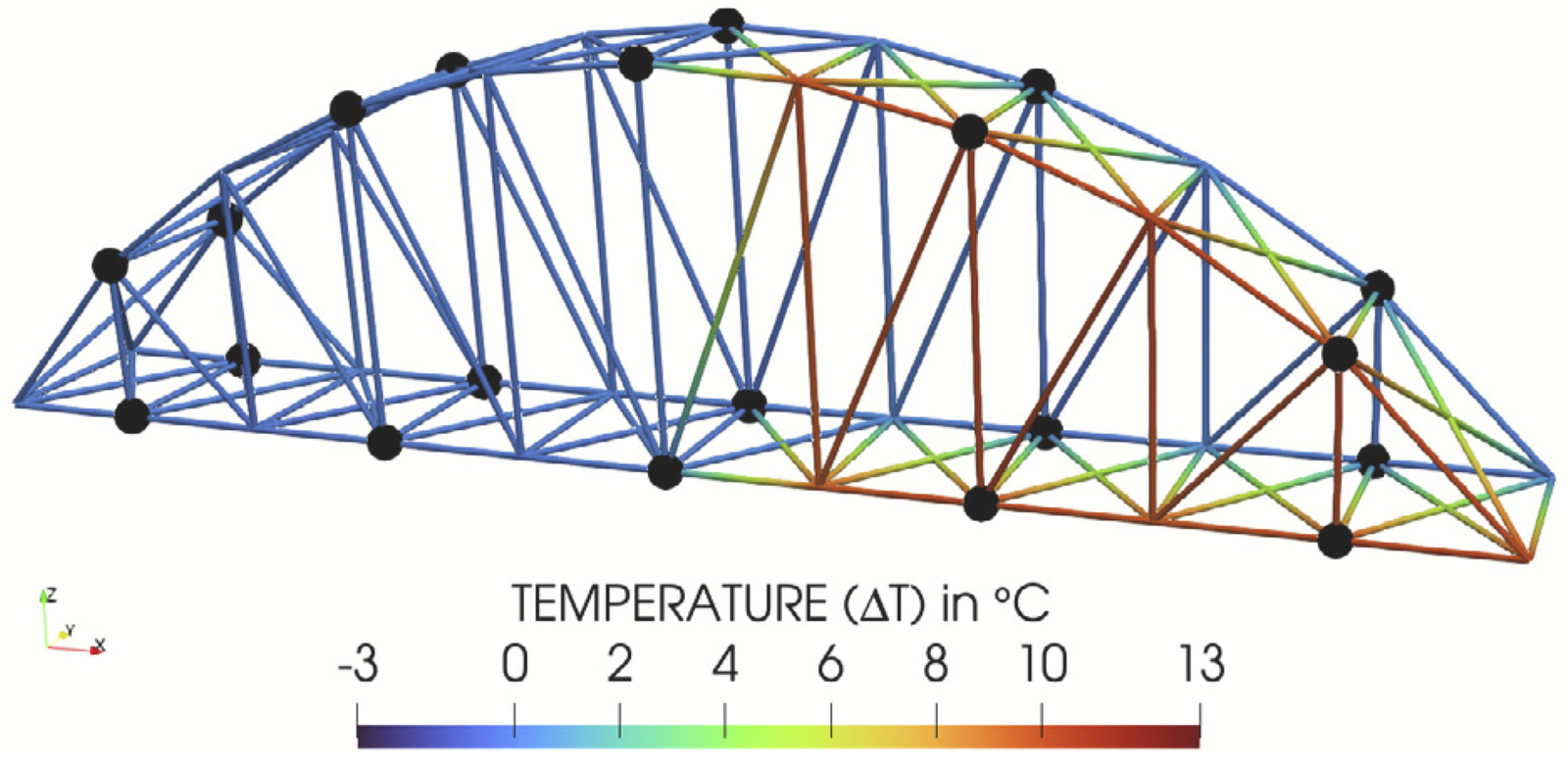
Thermal effects can deform a bridge, alter its stresses, and complicate the interpretation of damage indicators. DOC-TWIN considers the identification of such hidden loads from displacement measurements, using vector-valued models of linear elasticity.
For a structural domain \(\Omega\subset\mathbb{R}^d\), \(d\in\{2,3\}\), let \(\mathbf{u}\colon\Omega\to\mathbb{R}^d\) denote displacement, \(\mathbb C\colon\mathbb{R}^{d\times d}\to\mathbb{R}^{d\times d}\) the elasticity tensor, and \(\mathbf{f}_{\Delta T}\colon\Omega\to\mathbb{R}^d\) an effective thermal load. Both models below use the Navier–Lamé system
\[
\begin{aligned}
-\operatorname{div}(\mathbb C\boldsymbol{\varepsilon}(\mathbf{u}))
&=\mathbf{f}_{\mathrm{ext}}+\mathbf{f}_{\Delta T}
&&\text{in }\Omega,\\
\boldsymbol{\varepsilon}(\mathbf{u})&:=\tfrac12(\nabla\mathbf{u}+\nabla\mathbf{u}^{\mathsf T})
&&\text{in }\Omega.
\end{aligned}\tag{E}
\]
Here \(\mathbf{f}_{\mathrm{ext}}\colon\Omega\to\mathbb{R}^d\) collects known loads. Prescribed displacement conditions on \(\Gamma_D\subset\partial\Omega\) and compatible traction conditions on \(\Gamma_N:=\partial\Omega\setminus\Gamma_D\) complete the model.
Thermal-load identification
Given a measured displacement field \(\mathbf{u}_{\mathrm d}\colon\Omega\to\mathbb{R}^d\) and \(\alpha>0\), the first model balances agreement with the data and load regularization:
\[
\begin{aligned}
\min_{\mathbf{u},\,\mathbf{f}_{\Delta T}}\quad &
\frac12\|\mathbf{u}-\mathbf{u}_{\mathrm d}\|_{\mathbf L^2(\Omega)}^2
+\alpha\|\mathbf{f}_{\Delta T}\|_{\mathbf X},\\
\text{subject to}\quad &(E)\text{ and its boundary conditions},
\quad\mathbf{f}_{\Delta T}\in\mathbf X.
\end{aligned}\tag{P1}
\]
The vector-valued spaces \(\mathbf X\in\{\mathbf L^1(\Omega),\mathbf M(\Omega),\mathbf{BV}(\Omega)\}\) accommodate different load structures. Here \(\mathbf M(\Omega)\) denotes finite vector-valued Radon measures. The first two penalties promote localized loads; the bounded-variation norm supports sharp interfaces [11, 12].
Optimization subject to strain limits
The second model uses quadratic regularization and a local strain bound:
\[
\begin{aligned}
\min_{\mathbf{u},\,\mathbf{f}_{\Delta T}}\quad &
\frac12\|\mathbf{u}-\mathbf{u}_{\mathrm d}\|_{\mathbf L^2(\Omega)}^2+
\frac\alpha2\|\mathbf{f}_{\Delta T}\|_{\mathbf L^2(\Omega)}^2,\\
\text{subject to}\quad &(E)\text{ and its boundary conditions},
\quad\mathbf{f}_{\Delta T}\in\mathbf L^2(\Omega),\\
&|\boldsymbol{\varepsilon}(\mathbf{u})|\leq\zeta\quad\text{a.e. in }\Omega.
\end{aligned}\tag{P2}
\]
The positive bound \(\zeta\in L^\infty(\Omega)\) limits the magnitude of the strain tensor. This links load reconstruction and control to prescribed deformation limits in the structural model.
Making numerical error explicit
The exact solution of an inverse problem is generally unknown. A digital twin, therefore, needs an error certificate that can be evaluated from computed approximations. Convex duality relates the primal minimization problem to a dual maximization problem and provides the starting point for such certificates.
Let \((\mathbf{u},\mathbf{f}_{\Delta T})\) be an exact optimal state-load pair and \(\mathbf{z}\) an associated dual solution. Computed approximations are denoted by \((\mathbf{u}_h,\mathbf{f}_{\Delta T,h})\) and \(\mathbf{z}_h\); for the certificate, they must be admissible for the continuous primal and dual problems. If \(I\) is the primal functional and \(D\) the concave dual functional, strong duality gives \(I(\mathbf{u},\mathbf{f}_{\Delta T})= D(\mathbf{z})\). The primal-dual gap estimator then satisfies
\[
\begin{aligned}
\eta_{\mathrm{gap}}^2(\mathbf{u}_h,\mathbf{f}_{\Delta T,h},\mathbf{z}_h)
&:= I(\mathbf{u}_h,\mathbf{f}_{\Delta T,h})-D(\mathbf{z}_h)\\
&= I(\mathbf{u}_h,\mathbf{f}_{\Delta T,h})
-I(\mathbf{u},\mathbf{f}_{\Delta T})+D(\mathbf{z})-D(\mathbf{z}_h)\\
&=: \rho_I^2\!\left(\mathbf{u},\mathbf{f}_{\Delta T};\,
\mathbf{u}_h,\mathbf{f}_{\Delta T,h}\right)
+\rho_{-D}^2(\mathbf{z};\,\mathbf{z}_h).
\end{aligned}
\]
The quantities \(\rho_I^2\) and \(\rho_{-D}^2\) are the primal and dual energy errors. Their sum is obtained from the gap estimator using only admissible approximations and problem data; the unknown exact solutions are not needed to evaluate it. DOC-TWIN develops generalized Prager–Synge identities that express this gap in appropriate error measures for PDE-constrained optimization, without unknown multiplicative constants. These certificates strengthen the numerical reliability of reconstructed loads and associated DT predictions.
Recent work on the Signorini problem, gradient constraints, optimal insulation, and vectorial variational problems provides the mathematical foundation [1, 2, 3, 4]. PDE constraints add a substantial challenge: a discrete state and load generally satisfy only a discrete equation. Practical certificates require admissible reconstructions that respect the continuous equations, together with computable primal and dual energies.
Error certificates and adaptive resolution
The project studies both explicit control of the error in the discrete PDE solution operator and post-processing into continuously admissible state-control pairs. Local contributions of the primal-dual gap provide refinement indicators for adaptive finite element meshes. This connects the accuracy required by the digital twin to the spatial resolution actually needed in the computation. Numerical comparisons with residual-based adaptive methods use common optimal control benchmarks.
Convergence and efficient nonlinear solution
Discrete duality identities link a priori convergence analysis to the accuracy of iterative nonlinear solvers. They provide a basis for deriving error decay rates and for monitoring how closely a current iterate approximates the discrete optimum. Balancing solver accuracy and discretization error is particularly useful when a digital twin must be updated repeatedly.
From scalar prototypes to structural models
The mathematical development starts with scalar elliptic control problems, including nonsmooth regularization and gradient constraints [10]. These provide a tractable setting for deriving the identities, constructing admissible approximations, and studying convergence. The resulting framework is then extended to the vector-valued elasticity models above, linking the analysis to thermal-load identification, strain constraints, and structural benchmark geometries.
Verification, validation, and structural benchmarks
DOC-TWIN connects its mathematical developments to bridge and dam configurations from existing work on structural digital twins [5, 6, 7, 8]. Numerical verification and physical validation address complementary questions: how accurately the chosen mathematical problem is solved, and how well the model describes observed structural behaviour.
For numerical verification, the initiative Numerical Benchmarks for Digital Twins: Verification Case for Damage Localization in Structures [9] supplies finite element models and reference solutions for comparing identification methods. Relevant configurations, adapted to the convex models covered by the analysis, connect DOC-TWIN to reproducible structural test cases.
For physical validation, a concrete reference is the experimental Concerto bridge in [7], where measured displacements are used for structural identification. Application collaborations provide a route to further comparisons with experimental observations. The Vilnius footbridge geometry in [8] supplies another connection to a real structure, with identification tests based on prescribed reference fields.
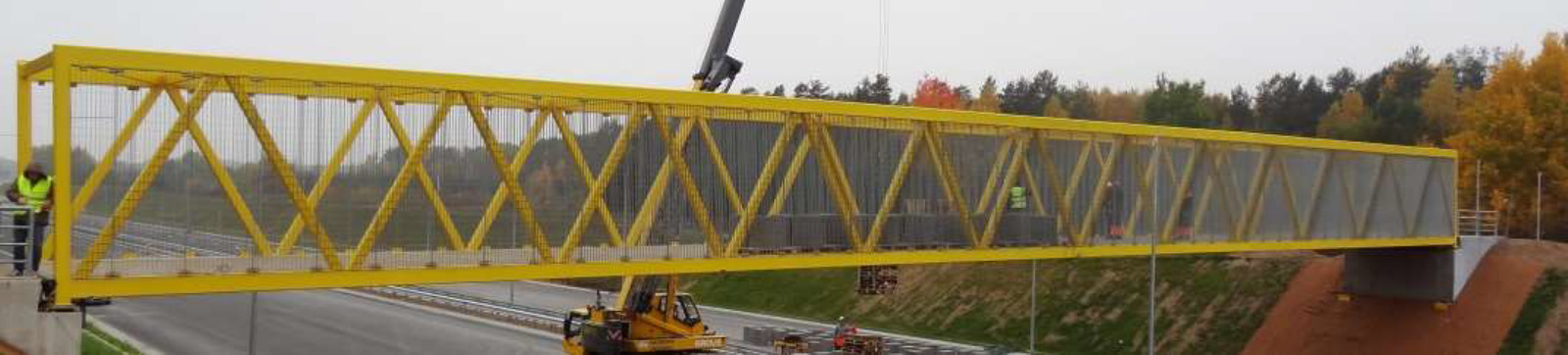
Explicit numerical error control forms one part of the reliability of a digital twin. Measurement uncertainty and modelling error enter the wider assessment separately. Keeping these sources of uncertainty distinguishable helps make the evidence behind safety-related decisions more transparent.
Fast updates through learned warm starts
An online digital twin encounters a sequence of closely related optimization problems as new observations arrive. This creates a direct connection to the DFG–NSFC project Learning-Enhanced Robust Iterative Methods for Non-Smooth and Constrained Variational Problems (LenhTVHM; DFG project 581203342), led by Sören Bartels, Yi Zhu, Alex Kaltenbach, and Shuo Yang.
Learned warm-start operators reuse information from previous solutions to accelerate repeated solves. DOC-TWIN explores their combination with admissible reconstructions and primal-dual gap estimators to make online digital twins faster and more robust while retaining explicit numerical error control.
Research connections
DOC-TWIN builds on research on structural digital twins at the Digital Twin Lab at George Mason University, including work with TU Braunschweig and the Technical University of Munich. These studies provide starting points for realistic structural benchmarks and potential collaborations on experimental validation.
Related and preceding initiatives include Harbir Antil’s projects Structure Preserving Optimization Algorithms and Digital Twins (NSF DMS-2408877) and Efficient Algorithms for Optimization with PDE Constraints (ONR N00014-24-1-2147), alongside the development of the Digital Twin Lab supported by an AFOSR DURIP award (FA9550-24-1-0022). They provide methodological and experimental background for the research envisaged in DOC-TWIN.
Beyond civil infrastructure, potential applications include constrained thermal models in semiconductor and electrochemical devices, energy systems, and other nonsmooth inverse problems.
External Website
Related Publications
Mathematical foundations and related application work. Further results will be added as DOC-TWIN progresses.
- S. Bartels, T. Gudi, A. Kaltenbach. A Priori and A Posteriori Error Identities for the Scalar Signorini Problem. SIAM J. Numer. Anal. 63(5), 2155–2186 (2025). doi:10.1137/24M1677691.
- H. Antil, S. Bartels, A. Kaltenbach, R. Khandelwal. Variational problems with gradient constraints: A priori and a posteriori error identities. Mathematics of Computation (2025). doi:10.1090/mcom/4146.
- H. Antil, A. Kaltenbach, K. L. A. Kirk. Duality-Based Algorithm and Numerical Analysis for Optimal Insulation Problems on Nonsmooth Domains. SIAM J. Control Optim. 64(3), 1235–1268 (2026). doi:10.1137/25M1758647.
- P. A. Gazca-Orozco, A. Kaltenbach. A Priori and A Posteriori Error Identities for Vectorial Problems via Convex Duality. Preprint (2026). arXiv:2602.04368.
- H. Antil. Mathematical Opportunities in Digital Twins (MATH-DT). Workshop report (2024). arXiv:2402.10326.
- T. S. A. Ansari, R. Löhner, R. Wüchner, H. Antil, S. Warnakulasuriya, I. Antonau, F. Airaudo. Adjoint-based recovery of thermal fields from displacement or strain measurements. Comput. Methods Appl. Mech. Engrg. 438, 117818 (2025). doi:10.1016/j.cma.2025.117818.
- I. Antonau, S. Warnakulasuriya, T. Ansari, R. Wüchner, R. Löhner, F. N. Airaudo, H. Antil. Advancing high-fidelity Digital Twin Technology for Structural Health Monitoring. Proceedings of SHMII-13, 1049–1056 (2025). doi:10.3217/978-3-99161-057-1-158.
- T. Ansari, S. Warnakulasuriya, I. Antonau, H. Antil, R. Löhner, R. Wüchner. One-Way Thermo-Mechanical Coupled System Identification Using Displacement and Temperature Measurements. Preprint (2026). arXiv:2603.09526.
- I. Antonau, S. Warnakulasuriya, T. Ansari, R. Löhner, H. Antil, R. Wüchner. Numerical Benchmarks for Digital Twins: Verification Case for Damage Localization in Structures. Preprint (2026). doi:10.2139/ssrn.6346317.
- M. Hintermüller, M. Hinze, R. H. W. Hoppe. Weak-Duality Based Adaptive Finite Element Methods for PDE-Constrained Optimization with Pointwise Gradient State-Constraints. J. Comput. Math. 30(2), 101–123 (2012). doi:10.4208/jcm.1109-m3522.
- M. Hintermüller, K. Kunisch. Total Bounded Variation Regularization as a Bilaterally Constrained Optimization Problem. SIAM J. Appl. Math. 64(4), 1311–1333 (2004). doi:10.1137/S0036139903422784.
- M. Hintermüller, G. Stadler. An Infeasible Primal-Dual Algorithm for Total Bounded Variation–Based Inf-Convolution-Type Image Restoration. SIAM J. Sci. Comput. 28(1), 1–23 (2006). doi:10.1137/040613263.
Related Pictures