

Project
AA-Tech-1
Anisotropic Microfluids — Fluctuations, Control, Effective Models and their Numerics
Project Heads
Benjamin Gess, Robert Lasarzik, Sandra May
Project Members
Giulia Cavalleri
Project Duration
01.03.2026 − 31.12.2027
Located at
WIAS
Description
Lab-on-a-chip devices aim to simplify laboratory functions by replicating them on a small scale in an automated manner. This innovation has the potential to revolutionize and democratize healthcare by making laboratory diagnostics more affordable and widely accessible. Precise control of fluid dynamics is crucial for automating laboratory functions on microfluidic chips. However, at small scales, pressure-driven flows become impractical due to the very low Reynolds number. Instead, electrokinetic flows—induced by an electric field—offer a promising alternative. Notably, an anisotropic medium has been observed to amplify electrokinetic flows, particularly in the presence of highly oscillating electric fields. This effect is illustrated in the numerical simulations below, where beside the molecular alignment the tracer plot of a flow induced by an oscillating electric field is shown.
The interplay between anisotropy, charge transport, the induced electric field, and fluid flow is highly complex, requiring thorough analysis to ensure reliable and transferable predictions. In the successfully completed MATH+ project AA2-12, the analysis and simulation of anisotropic microfluids were studied.
The interplay between anisotropy, charge transport, the induced electric field, and fluid flow is highly complex, requiring thorough analysis to ensure reliable and transferable predictions. In the successfully completed MATH+ project AA2-12, the analysis and simulation of anisotropic microfluids were studied.
This unveiled the system’s sensitivity to changes in the director’s orientation. Even a slight variation in this anisotropy can significantly alter the induced flow, given the same initial charge distribution and boundary control of the electric field. This implies both the risk of amplifying fluctuations, and the potential benefit of sensitivity with respect to controls. On the one hand, it is well established in physics that the locally averaged molecular orientation, which determines anisotropy, is subject to statistical fluctuations. Given that small changes in the anisotropy can have a substantial impact on fluid flow, e.g., by triggering tipping points, it is essential to account for these fluctuations in order to achieve precise and reliable control in microfluidic devices.
On the other hand, given the system’s sensitivity to anisotropy, controlling the resulting flow via the alignment direction is a fast and economical approach. Notably, due to the optimal control formulation of action functions in rare event analysis, both risk and potential benefit are closely related.
The project takes into focus both the potential risks, by developing a rare events analysis both theoretically and numerically, as well as the potential benefit, by the design of optimal control strategies, and their numerical simulation.
External Website
https://www.wias-berlin.de/research/ws/w4/third_party/
Related Publications
- B. Fehrmann and B. Gess, Non-equilibrium large deviations and parabolic-hyperbolic PDE with irregular drift, Invent. Math.,243(2):573-636,2023.
- B. Gess, D. Heydecker, and Z. Wu, Landau–Lifshitz–Navier–Stokes Equations: Large Deviations and Relationship to the Energy Equality, Preprint, arXiv:2311.02223 [math.PR], 2023.
- R. Lasarzik and M. E. V. Reiter. Analysis and numerical approximation of energy-variational solutions to the Ericksen–Leslie equations. Acta Appl. Math., 184:44, 2023. Id/No 11
- R. Lasarzik. Approximation and optimal control of dissipative solutions to the Ericksen–Leslie system. Numer. Funct. Anal. Optim., 40(15):1721–1767, 2019.
- S. May, R. Rannacher, and B. Vexler. Error analysis for a finite element approximation of elliptic Dirichlet boundary control problems. SIAM J. Control Optim., 51(3):2585–2611, 2013.
- Schorlepp, T. Grafke, S. May, and R. Grauer. Spontaneous symmetry breaking for extreme vorticity and strain in the three-dimensional Navier–Stokes equations. Philos. Trans. R. Soc. A, 380(2226):20210051, 2022.
Related Pictures

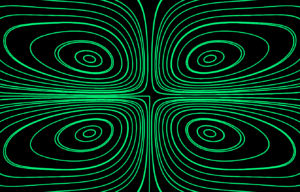
Alignment of elongated molecules in the considered solvent and numerically calculated resulting flow, where highly oscillating electromagnetic field is induced via boundary control.

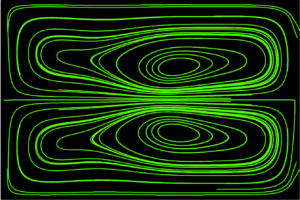
Alignment of elongated molecules with a slightly changed alignment int he middle and numerically calculated resulting flow, where highly oscillating electromagnetic field is induced via boundary control.