

Young African Mathematician Program: Interview with the YAM Fellows 2025-2026
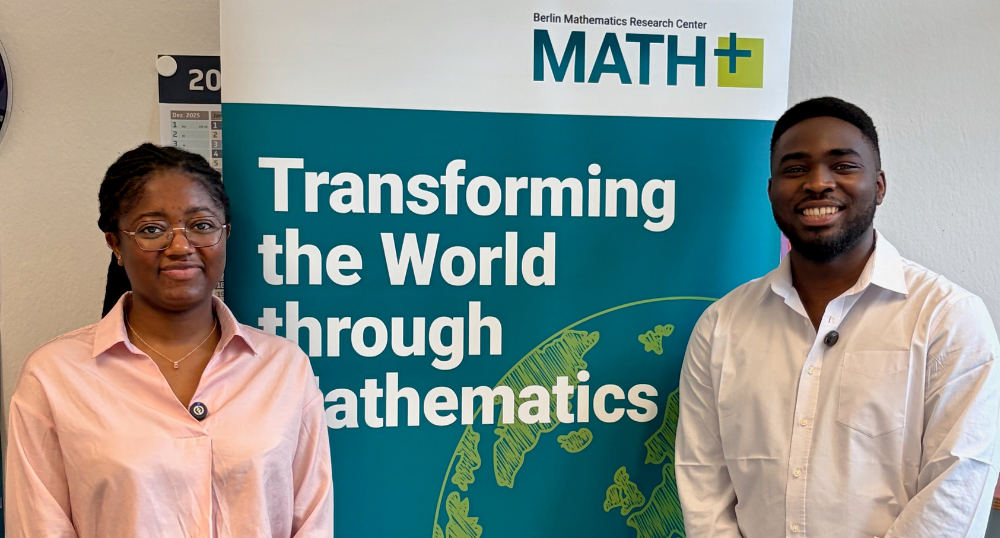
MATH+ is a partner in the Young African Mathematicians (YAM) Fellowship Program, which brings together a network of five African Institute for Mathematical Sciences (AIMS) centers in Cameroon, Senegal, Rwanda, Ghana, and South Africa, as well as four German Clusters of Excellence mathematics located in Berlin, Bonn, Heidelberg, and Münster. The program provides fellowships to talented and motivated young African mathematicians at the master’s level who seek research experience in their chosen field.
The current YAM Fellows at MATH+, Kessel Wilson Mbouche Nzali (Host: Christian Bayer, TU Berlin/WIAS) and Manuella Kristeva Nakam Yopdup (Host: Sebastian Pokutta, TU Berlin/ZIB), share their academic journeys and first impressions of Berlin. In this interview, they talk about research and teaching cultures in Germany and Cameroon, life abroad in a new city, and their ambitions to pursue a PhD and make an impact in Africa in the future.
Kessel Wilson Mbouche Nzali from Cameroon holds a Bachelor’s and a Master’s degree in Mathematics from the University of Dschang, Cameroon. During his Master’s studies, he developed a strong interest in mathematical finance and received a scholarship to study at the University of Padova, Italy, where he worked on option pricing using quantization techniques and Fourier transform methods. After defending his Master’s thesis in Cameroon, he joined AIMS to further strengthen his training in advanced mathematics.
Since arriving in Berlin, he has attended courses in stochastic mathematical finance and control theory. After completing the fellowship, Kessel aims to pursue a PhD in stochastic analysis and its applications to mathematical finance. He hopes that this advanced training will enable him to contribute to research and teaching as well as tsupport the development of STEM education in Africa.
Manuella Kristeva Nakam Yodup completed her Bachelor’s and Master’s degrees in Computer Science, with a focus on data science and artificial intelligence, at the University of Yaoundé, Cameroon. Her interest in data science led her to pursue applied mathematics at an AIMS Centre in Rwanda. Her research interests lie at the intersection of AI and healthcare. Through the fellowship, she is deepening her experience in artificial intelligence, particularly in healthcare-related applications, while benefiting from the interdisciplinary research environment at TU Berlin and the Zuse Institute Berlin. This experience also allows her to assess her readiness for pursuing a PhD.
Following the fellowship, she hopes that this advanced training will enable her to contribute to research and teaching as well as support the development of STEM education in Africa. Her long-term goal is to apply AI-driven methods to medical research, especially in areas such as disease modeling and drug discovery.
******
INTERVIEW WITH THE TWO YAM FELLOWS
The interview was conducted in January 2026 by Beate Rogler, MATH+ PR Manager.
The conversation provided numerous valuable insights into the lives of the two Young African Mathematician (YAM) Kessel and Manuella who came to the Berlin Mathematical School (BMS) in Berlin through the MATH+ YAM program for the 2025-2026 academic year. They spoke about their first impressions of Berlin, differences in university culture compared to their home institutions in Cameroon, and about their academic goals and future plans.
MOTIVATION FOR THE YAM FELLOWSHIP
Manuella and Kessel, you are part of the MATH+ Young African Mathematician Program and will stay in Berlin until summer 2026. We are very happy to have you here. Could you tell us why you were interested in studying in Germany through the YAM Fellowship?
Kessel: Germany, and especially Berlin, is an ideal place to study mathematics—particularly financial mathematics, which is the field of interest. There are many experts working in this area, so the fellowship offers a great opportunity to learn from leading researchers.
Manuella: For me, the YAM Program was a great opportunity to experience research in a strong academic environment and to work closely with experienced researchers. I wanted to see whether this environment would suit me for pursuing a PhD over the next three to four years, possibly in Berlin.
FIRST IMPRESSIONS OF BERLIN
Did anything surprise you when you first arrived in Berlin?
Kessel: The public transport system was quite a challenge. On my first day, I was late for a meeting because I didn’t yet understand how the system works and got lost. That was my first real experience with German punctuality—my meeting partner was not happy about the delay. Despite this, I really appreciate the warm welcome from Annika, the BMS coordinator, the BMS team and the BMS student group, who organized many activities that helped us feel comfortable and explore Berlin, which is a beautiful city
Manuella: It was the same for me. The transportation system is difficult to understand at first. In the beginning, I didn’t know when to get off to take another bus and was confused when the bus was delayed. That’s why I also arrived late to the orientation. So, adapting to the transport system was challenging, especially since it is supposed to be punctual but is not always reliable. And yes, the BMS team and student group is very kind and welcoming.
ACADEMIC CULTURE AND TEACHING
How does studying in Berlin compare to your home universities in Cameroon, Rwanda, or Italy?
Kessel: In Italy, where I could study for a few months during my master’s study, classes were much larger than here in Berlin, but the teaching style is quite similar. In Cameroon, teaching is usually in French while at AIMS it is in English. Lecturers in Cameroon tend to be stricter regarding course content, which is common in many African universities, and students usually take several exams per course. In Berlin, having only one exam per course was surprising to me. Another major difference I the relationship with professors: in Berlin, it is more open and interactive. I really appreciate being able to ask questions freely and discuss topics with lecturers outside the class. One of my courses in mathematical finance is particularly well taught and fits my learning style very well.
GOALS AND FUTURE PLANS
What are your goals during your stay in Berlin?
Kessel: My main goal is to gain research experience, learn from experts, and build an international academic network. I am working on a research project related to cubature methods on Wiener space for option pricing, which is highly relevant to my interests in financial mathematics. I hope we achieve interesting results. In the long term, I hope to secure a PhD position in Berlin or Austria in order to contribute to solving mathematical problems and publishing research papers, although the competition is fierce.
Manuella: I hope to build a strong research network that will be useful for the next stage of my research journey. Currently, we are working on the pruning of large language models (LLMs) and it would be great to publish my first paper. I would like to pursue a PhD focusing on AI applied to healthcare, particularly in areas such as cancer research or osteoporosis. Thus, I want to contribute to the healthcare systems in Africa using AI, especially in drug discovery.
You’re right—obtaining a PhD position is highly competitive, but I sincerely hope that you will be successful. It was a pleasure talking to you.
Manuella: We would also like to thank MATH+ and the BMS for the wonderful opportunity to learn and to be involved in mathematical research. It is an outstanding program.
Kessel: Yes, and we are also having a great time here in Berlin.
Thank you very much for sharing your insights into your stay in Berlin. We wish you a successful and enjoyable time until the program ends in the summer!