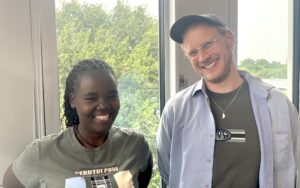
Interview:
BR: Welcome to Berlin, Caroline, and congratulations on receiving the Hanna Neumann Fellowship! What does this recognition mean to you?
CN: Thank you. For me, there are two things. First, it shows that someone without the kind of strong academic background that people often expect in Europe can still achieve something and be good at it. Second, it means that I have a platform to build networks and collaborate with other researchers. So, it has two meanings for me: it shows that, regardless of where you come from, you can achieve anything in life. And it also gives me the opportunity to create a network or a platform for collaboration.
BR: What sparked your interest in mathematics? Did you know as a child or teenager that you wanted to study mathematics?
CN: I never thought I would do mathematics as a career. If anything, I thought I would go into statistics, which means using mathematics rather than doing mathematics itself. But my interest in mathematics started during an undergraduate course on rings and modules because the lecturer made the subject really interesting to me. I thought, “Maybe I can do this and see where it takes me.” And by sheer luck, I ended up in mathematics, and I’ve never looked back.
BR: What was your major during your bachelor’s studies? Was it mathematics, or another subject?
CN: The program was a Bachelor of Science with Education, which meant I was training to become a secondary school teacher. I studied both mathematics and economics, but I majored in mathematics because economics involved a lot of memorization, which I didn’t like very much. In mathematics, you learn the formulas and then you apply them. At that time, though, I didn’t realize you could pursue mathematics itself as a career.
BR: What has been your experience as a women in mathematics? What challenges do women face if they want to study mathematics and pursue a career in the field?
CN:From my perspective, many women tend to be perfectionists. They want everything to be just right and in its proper place. I think I’m a perfectionist too, even though I don’t like to admit it. I’ve noticed that many women want everything in their life to be perfectly organized and in straight line. Sometimes that’s a strength, but it also comes with two major challenges.
First, mathematics is never perfect and really finished. You solve one problem and another one comes out of it. There’s always another challenge, another question, another way to improve what you’ve done. You’ll never reach a point where everything is perfect.
Second, you can’t serve two masters at once. Many women also have other responsibilities. They may have families, children, cooking, and many other demands on their time. It’s very difficult to give everything your full attention and expect to do all of it perfectly. Because of these competing responsibilities, many women feel they can’t devote themselves to mathematics in the way they’d like. That’s the challenge I see for many of them. Eventually, when they have to make a choice, they often give up the more demanding path, and mathematics is usually the more demanding one. They choose a different career instead. For example, I could have become a secondary teacher, but I decided not to go back in my pursuits. Once I started my master’s degree in mathematics, I realized I had so much invested in mathematics that I didn’t want to leave it there. I wanted to give something back to the community—for example, by mentoring others, just as I was mentored by very excellent teachers and mathematicians.
BR: How many women were in your classes?
CN: During my undergraduate studies, I can’t really remember. But in my master’s program, there were about twelve students altogether in pure and applied mathematics. In my class, there were only two women. That’s not many. Then, during my PhD, there were three other students, all men, and I was the only woman.
BR: Could you describe your research in a way that’s accessible to the general public? And how does it connect to your work here in Berlin?
CN: I’m interested in classification problems in algebraic geometry. More specifically, I study algebraic varieties, both with and without singularities, and I look at their derived categories of coherent sheaves.
One of the things we study is something called derived equivalences. These give rise to groups of derived auto-equivalences, which are symmetries of the derived category. Those groups act naturally on what is called stability space, or stability manifold.
Dominic, at TU Berlin, approaches related questions from a different direction. He studies automorphisms groups of projective varieties. He is interested in how those automorphism groups act on the stability space or stability manifold. So we’re looking at similar questions from different perspectives. Our work intersects in a very natural way, which makes this collaboration a great fit for both of us.
BR: What are you most excited about your collaboration with Dominic and his research group?
CN: It’s really exciting because I get to learn new mathematics. The group works mainly in algebraic and discrete geometry, and I don’t know very much about discrete geometry yet. So this collaboration gives me the opportunity to learn a new area of mathematics, explore new ideas, and broaden my perspective.
BR: And do you think this will help you in your future career?
CN: Yes, definitely. For me, mathematics is like a precious stone. You can never take in the whole stone—you just keep chipping away at it, little by little. You collect small pieces of it, keep them in your mind, or write them down for others to read, even a hundred years from now, long after you’re gone.
So, for me, learning from this group is another way of collecting new pieces of that stone. I’m gaining new ideas and new perspectives that I can use in the future, whether I want to decide to write about them or simply think about them. You can’t work on the same mathematics all the time. You have to explore different directions because sometimes one line of research reaches a dead end. When that happens, you move on and try another direction.
The more pieces of that precious stone you’ve collected over time, the better prepared you are. It’s like storing food for tomorrow—you already have something to build on. I learn from one group, then from another, and gradually bring all of that knowledge to together. I’m sure that will be very valuable, both now and in the future.
BR: What do you think will be the greatest benefit of this collaboration? You mentioned learning a lot and being exposed to different mathematical ideas and approaches. Is there anything else that stands out to you?
CN: This fellowship also gives you visibility. For example, through interviews like this, people learn about your work and the kind of mathematics you’re doing. It helps others recognize you as a researcher. That can lead to new opportunities to collaborate with other mathematicians in the future. So, for me, it’s really a platform to building connections, collaborating, and exchanging ideas in both directions.
BR: What are your professional goals for the coming years?
CN: I started a position as a lecturer at Makerere University in Kampala, Uganda, in June 2026. Through that role, I really want to give something back to the mathematics community—and to the wider community as well.
One of the best ways I can do that is by mentoring young mathematicians. I want to encourage people to see mathematics from a different perspective and show them that they can succeed, regardless of whether they come from a privileged background or have had exceptional educational opportunities.
At the same time, I want to do as much mathematics as possible because it’s something I truly enjoy. For me, doing mathematics is a way of living to the fullest.
BR: Will you still have time for research, or will you focus mainly on teaching?
CN: My position includes teaching, advising master’s students and PhD students, and conducting my own independent research. All of that fits well with what I want to do—giving back to the community and mentoring others.
Balancing those responsibilities won’t always be easy, but that’s something mathematicians everywhere have to do. Even in Europe, mathematicians have to teach, although some have lighter teaching loads. I’m hoping I’ll manage it well.
BR: Apart from your position as lecturer, do you have other dreams for the future?
CN: I feel that my life is in a very good place right now. Everything seems to be coming together. Throughout my career, I’ve had the opportunity to meet many outstanding mathematicians. My hope is that I can be as good or even better than they are in mathematics.
BR: We always like to ask the Hanna Neumann Fellows about women in mathematics, since the fellowship is named after the remarkable mathematician Hanna Neumann.
What advice would you give to young women who are considering studying mathematics or pursuing a career in the field? Do you think you have a perspective that is different from that of male mathematicians?
CN: My advice is simple: anyone can do it. Any woman—or anyone else— can succeed in mathematics. You need some talent, of course, but just as importantly, you need to set your priorities right.
For women who want to pursue mathematics, I’d say it’s a step-by-step journey. You don’t have to accomplish everything at once. Focus on what’s most important at the moment, and trust that the rest will fall into place over time.
Many people will tell you that you can’t do it. They may say you don’t belong, or that you’re only succeeding because you’re being given special opportunities. Those kinds of comments can be discouraging. But the important thing is to stay focused on your own goals. Set your priorities, look at women and men who have succeeded before you, and remember that if they could do so, you can too.
BR: That’s wonderful advice, Caroline. Thank you very much for sharing your insights and experiences with us. We wish you a productive and inspiring collaboration with your host and MATH+ member at TU Berlin, Dominic Bunnett, and every success in your future career and professional life.