

MATH+ Dissertation Awards 2025
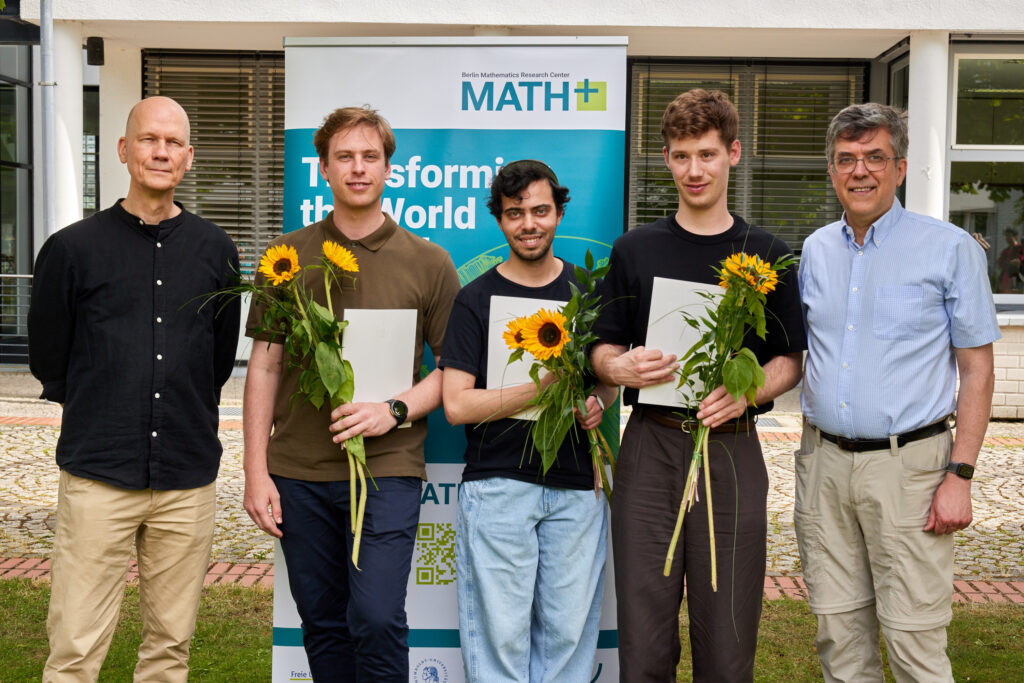
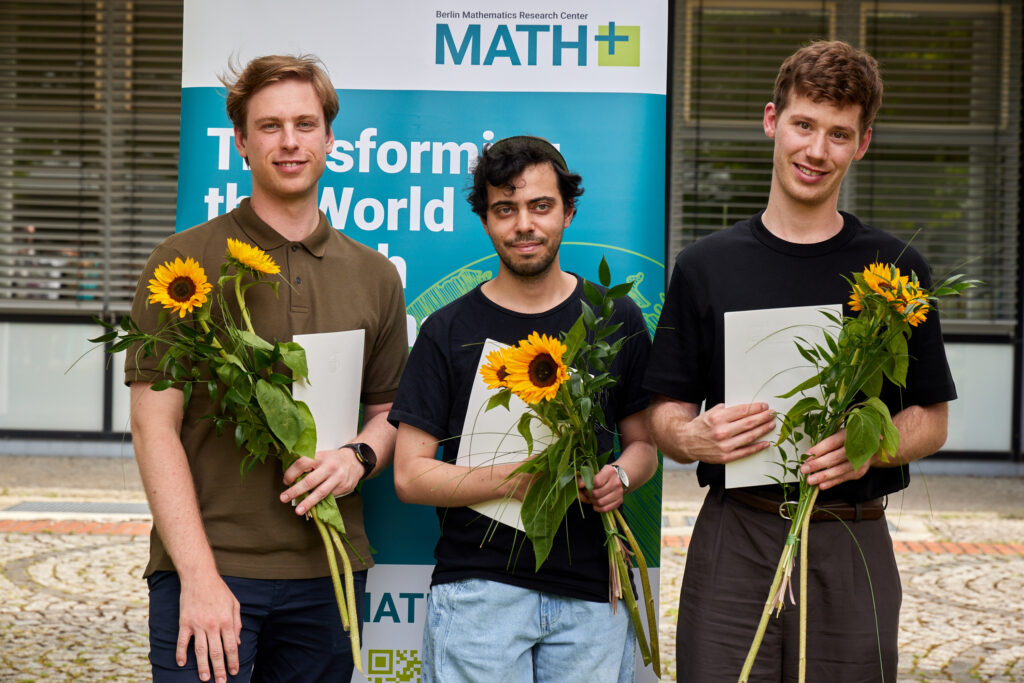
First photo: MATH+ Dissertation Award recipients with BMS Chairs Holger Reich (left) and John M. Sullivan (right) | All photos: © Julia Baier / MATH+
In cooperation with the Einstein Foundation Berlin, the Berlin Mathematical School (BMS) of the Cluster of Excellence MATH+ awards annual prizes for outstanding dissertations by BMS graduates. We are delighted that the MATH+ Dissertation Awards 2025 were presented to Benedikt Gräßle, Moritz Grillo, and Vasily Rogov in recognition of their outstanding dissertations on 10 July 2026 at the BMS Certificate Ceremony. Congratulations!
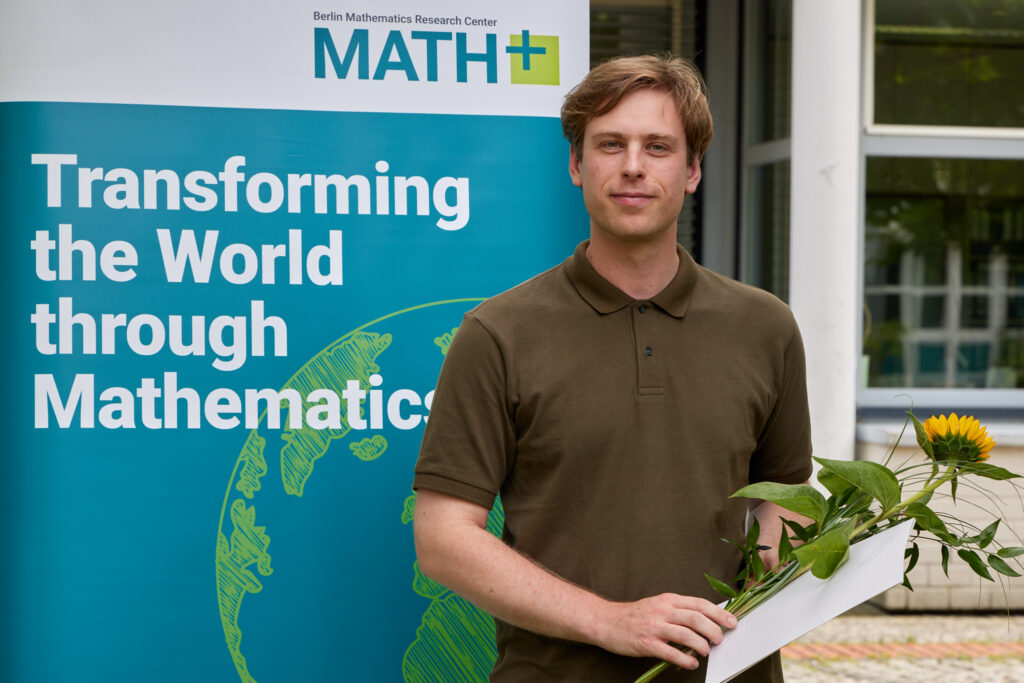
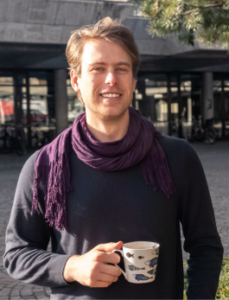
Benedikt Gräßle
Benedikt Gräßle is a postdoctoral researcher in numerical analysis at the University of Zurich (UZH). He studied mathematics and computer science at Humboldt-Universität zu Berlin (HU Berlin) and completed his PhD at the Berlin Mathematical School (BMS) under the supervision of Carsten Carstensen (HU Berlin) in 2024.
His research focuses on developing numerical methods with rigorous mathematical guarantees. During his doctoral studies, he investigated adaptive finite element methods and error control for semilinear partial differential equations. His current interests include wave propagation and boundary integral formulations. More broadly, his work combines mathematical analysis and efficient algorithms to enhance the reliability and efficiency of scientific simulations in applications ranging from fluid mechanics to acoustic scattering.
Dissertation “A posteriori nonconforming finite element error analysis for fourth-order problems with quadratic semilinearity”
Modern science and engineering rely on computer simulations, from predicting airflow around an aircraft wing to assessing the stability of bridges. Yet these simulations never solve the underlying equations exactly. Instead, they produce approximations, raising a fundamental question: How much confidence can we place in their predictions?
The dissertation develops mathematical methods to answer that question for models arising in fluid and solid mechanics. It introduces novel finite element methods that combine high accuracy with computational efficiency. Central to these methods are computable error estimators that quantify the reliability of numerical solutions. These estimators drive adaptive algorithms that automatically concentrate computational effort where it is most effective. The thesis also develops verification techniques that guarantee that computed solutions represent genuine physical states, providing rigorous foundations for trustworthy scientific simulations.
More information is available on his personal website.
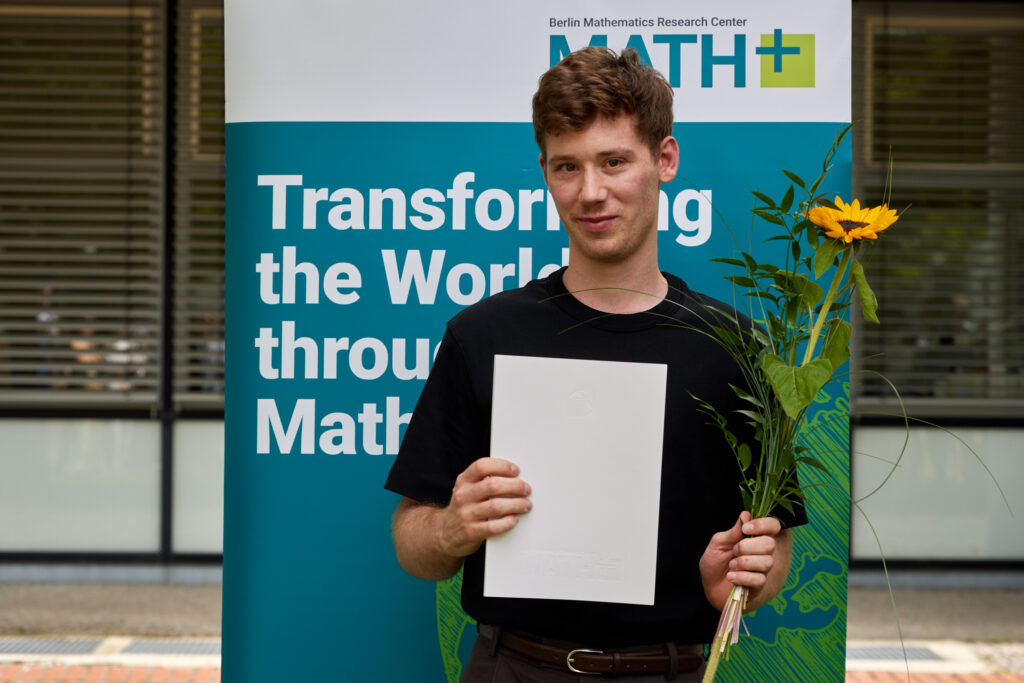
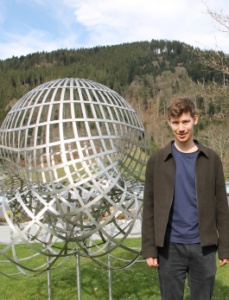
Moritz Grillo
Moritz Grillo studied mathematics at the University of Greifswald, earning his B.Sc. in 2020 and his M.Sc. in 2022. In 2019, he spent an exchange semester at the Federal University of Santa Catarina (UFSC) in Florianópolis, Brazil. He then moved to Technische Universität Berlin (TU Berlin) for his doctoral studies and completed his PhD in 2025 under the supervision of Martin Skutella.
His doctoral research was conducted within the MATH+ project “On the Expressivity of Neural Networks” of the Application Area “Next Generation Networks” and investigated the mathematical structure, expressive power, and verification of ReLU neural networks using methods from polyhedral geometry, topology, combinatorics, and computational complexity. Since completing his PhD, he has been a postdoctoral researcher at the Max Planck Institute for Mathematics in the Sciences (MPI MiS) in Leipzig, working in the DFG Priority Programme SPP 2298 “Theoretical Foundations of Deep Learning,” on combinatorial and implicit approaches to deep learning.
Dissertation “Expressivity and Complexity of ReLU Neural Networks”
Moritz Grillo’s dissertation studies neural networks with ReLU activations, one of the basic building blocks of many modern AI systems. Mathematically, these networks represent continuous piecewise-linear functions: they partition the input space into regions and apply a linear rule on each of them. This perspective enables the analysis of learning models using tools from geometry, topology, combinatorics, and computational complexity. The dissertation investigates what kinds of shapes and functions ReLU networks can represent, how depth and size affect their expressive power, and how difficult it is to verify properties such as whether a network is one-to-one or covers a whole target space. Its goal is to contribute to a rigorous understanding of why these networks are powerful, where their limitations lie, and how their structure can be described mathematically.
More information is available on his personal website.
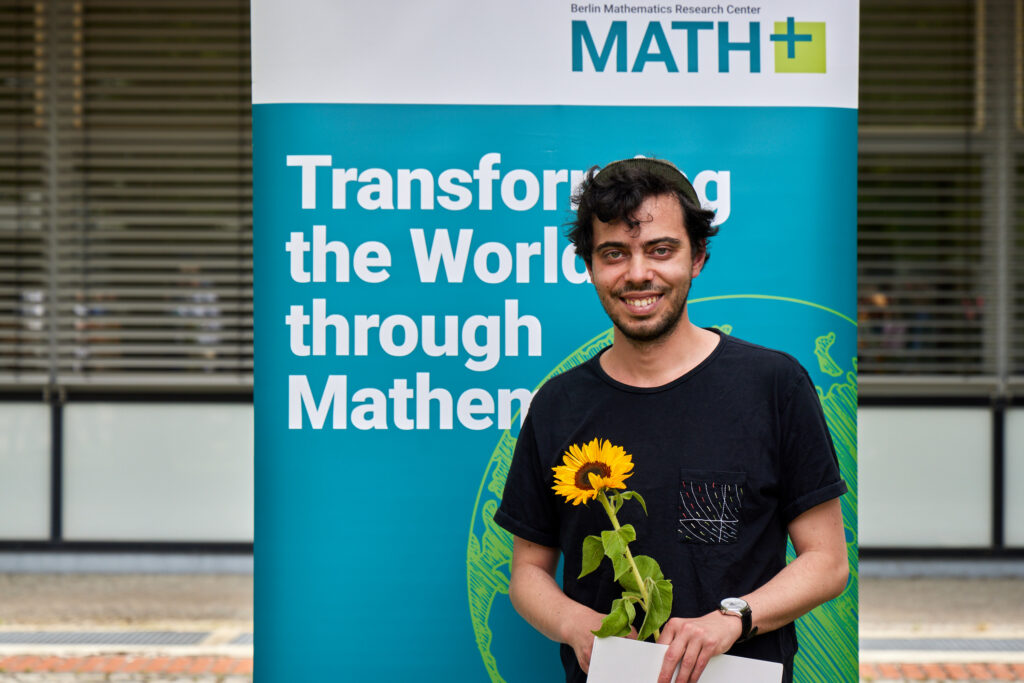
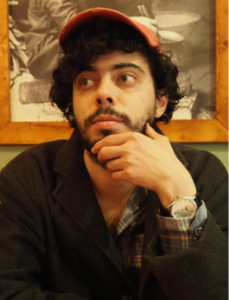
Vasily Rogov
Vasily Rogov was born in 1997 in Moscow. At the age of 13, he enrolled in a specialized math program that offered advanced mathematics sessions beyond the standard curriculum, including university-level material. As a child, Vasily actually preferred literature and history to mathematics. What attracted him to mathematics was the challenge of solving difficult problems and understanding concepts that require a different way of thinking.
After graduating from school, he enrolled in the Department of Mathematics at the Higher School of Economics (HSE) in Moscow where he studied foundational courses and began conducting his own research. During his studies, he also spent a semester in Paris as an exchange student. While at HSE, Vasily started reading papers by Bruno Klingler and became interested in his work. This led him to ask Klingler to supervise his PhD, prompting a move to Berlin at Humboldt-Universität zu Berlin in 2020. After defending his dissertation in 2024 at HU Berlin, he joined the Max Planck Institute for Mathematics in the Sciences (MPI MiS) in Leipzig as a postdoctoral researcher. From October 2026, he will join Ludwig Maximilian University (LMU) in Munich as an Academic Advisor.
Dissertation “Bialgebraic geometry and fundamental groups of quasi-projective varieties”
One of the central ideas in mathematics since the Renaissance has been the use of algebraic equations to describe geometric objects. For example, the equation x+y=0 defines a line, while x²+y²=1 defines a circle. This powerful approach enables rigorous reasoning about complex multi-dimensional objects and reveals hidden symmetries. Just as in life, where the words we use shape how we perceive reality, in mathematics the language of description influences the objects being described. For instance, a curve resembling an “infinite wave” cannot be described by algebraic formulas alone; it requires a non-algebraic function such as the “sine” function. Vasily Rogov’s dissertation explores this effect at a deeper level. Its main result shows, roughly speaking, that if a space carries a geometric structure forming a repeating (periodic) pattern, then it cannot be described by a finite set of algebraic formulas, unless that structure is homogeneous (i.e., the space looks “the same” at every point). The dissertation also explores how the existence of an algebraic description constrains the topology of the space, namely those fundamental properties that remain unchanged under continuous deformations.
More information is available on his personal website.