The Hanna Neumann Fellows 2025
Second Interview with Monika and Alice Marveggio
In January 2026, after their research stay at MATH+ in Berlin


Transforming the World
through Mathematics
Second Interview with Monika and Alice Marveggio
In January 2026, after their research stay at MATH+ in Berlin
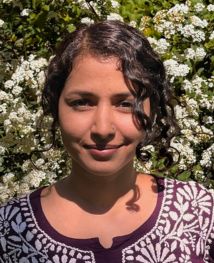
Monika is a Research Associate at the Statistics and Mathematics Unit of the Indian Statistical Institute Kolkata, India. She obtained her PhD in 2024 from the Indian Institute of Science Education and Research, Bhopal, India. After that, she held a postdoctoral position at the Indian Institute of Technology, Gandhinagar, India. Monika’s research interests lie in low-dimensional topology, knot theory, and contact and symplectic geometry. She is currently working on several projects related to the classification problem for Legendrian knots and 3-dimensional contact manifolds. Supported by the MATH+ Hanna Neumann Fellowship, Monika collaborated with Marc Kegel and his research group at Humboldt-Universität zu Berlin.
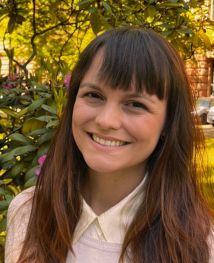
Alice Marveggio is a Postdoctoral Researcher at the Hausdorff Center for Mathematics (HCM) in Bonn. She received her PhD in 2023 from the Institute of Science and Technology Austria (ISTA). Prior to that, she completed her bachelor’s and master’s degrees in physics at the University of Pavia, Italy. Alice’s research interests lie at the intersection of partial differential equations and the calculus of variations, with a particular focus on interface evolution problems arising in continuum mechanics. Starting in October 2025, her research in Bonn will be funded by the Alexander von Humboldt Foundation (AvH). She collaborated with Barbara Zwicknagl‘s group at Humboldt-Universität zu Berlin during her MATH+ Hanna Neumann Fellowship research stay in Berlin.
In this interview, the Hanna Neumann Fellows (HNF), Monika and Alice, share insights from their research stay in Berlin in 2025 and reflect on their research focus, collaborations, and future plans.
I. RESEARCH FOCUS IN BERLIN
Your research areas—interface evolution problems for Alice and low-dimensional topology for Monika—are quite specialized. Could you describe your research focus for a general audience, particularly the aspects related to your HNF research stay at MATH+?
A: My research interests lie at the intersection of partial differential equations and the calculus of variations, with a particular focus on interface evolution problems arising in continuum mechanics. An interface is a surface separating two spatial regions occupied by two different physical states, often referred to as phases. Interfaces play a central role in modeling a wide range of physical phenomena, including two-phase fluid flows, grain coarsening, crystal growth, tumor growth, and the behavior of biological membranes. During my stay in Berlin, we worked on a project aimed at advancing the understanding of a variational model for pattern formation in biological membranes.
M: In low-dimensional topology and geometry, mathematicians study objects such as knots, links, surfaces, and three- and four-dimensional manifolds. My research interests focus on classification problems for knots and for three-dimensional manifolds equipped with additional geometric structures, particularly contact structures. Links play a central role in this area: not only is their intrinsic study rich and interesting, but every three-dimensional manifold can be obtained via Dehn surgery along a link. During my stay, I worked on understanding Dehn surgeries in the context of contact manifolds.
II COLLABORATIVE IMPACT
The HNF program offers a unique opportunity to collaborate closely with researchers at MATH+. How has working with your hosts and their research groups inspired new ways of thinking about your work or helped advance your research?
A: During my research stay, I had the valuable opportunity to interact with and exchange ideas with many researchers in Berlin. Barbara welcomed me warmly and introduced me to her current research group at Humboldt Universität. We initiated an interesting joint project together with two of her former group members, who are now based at WIAS. I was also honored to give a seminar at WIAS, where my research was met with strong interest and engaging discussion from the audience. In addition, I reconnected with a former colleague living in Berlin, which allowed us to resume our discussions on a shared research line.
M: The research stay was very fruitful for me. During those three months, I experienced both personal growth and academic development. Marc and his research group welcomed me very warmly, and we had many mathematical as well as non-mathematical discussions. He suggested several interesting research articles for me to read in order to expand my research background. He also invited me to give a talk in their working group seminar, which allowed me to interact with researchers working in my area of interest. As a result of our mathematical discussions, I developed many new research ideas that I plan to pursue in near future.
III. CHALLENGES AND INNOVATIONS
Have you encountered any unexpected challenges or surprising insights during your research stay in Berlin?
A: Overall, the research stay went very smoothly, and I did not encounter any major unexpected challenges. One pleasant surprise was the level of engagement and openness of the research community in Berlin, which led to several fruitful discussions and new collaborations. These exchanges significantly enriched my perspective on the research topics I am working on.
M: My research stay went very smoothly. There were not many challenges that I faced. However, some surprising insights emerged from the joint work with Marc Kegel. That realization led us to a new project which I also worked on during my stay in Berlin. It is not possible to explain this insight here without extensive mathematical discussion, but it relates to homotopy invariants of vector bundles on three-manifolds, In particular, we observed that for certain classes of manifolds, not all of these homotopy invariants are actually necessary.
IV. CAREER AND KNOWLEDGE BUILDING
How do you see the outcomes of your Berlin research stay—such as publications, new methods, or collaborations—contributing to your career development and future research goals?
A: I have already benefited greatly from my research stay in Berlin and expect to continue doing so in the future. The discussions with researchers there were highly fruitful, particularly in terms of learning new methods and gaining new ways of thinking. The project we initiated addresses a topic that is new to me, and working on it will undoubtedly enrich my knowledge and skills.
M: I benefited from my research stay in Berlin in many ways. I learned a great deal from attending weekly seminars at Humboldt Universität. My stay in Berlin also allowed me to travel within Germany, attend conferences, and start new collaborations that would not have been possible otherwise. In addition, the project we started during my stay “Contact Surgery Distance,” is now completed and now available on arXiv.
V. FUTURE COLLABORATIONS
Do you plan to continue your research collaboration with your colleagues in Berlin? If so, how do you envision this collaboration developing?
A: I fully intend to continue my research collaboration with my colleagues in Berlin, as we aim to further develop and complete the project we initiated. To this end, one of the colleagues from Berlin will soon visit me at my university, allowing us to continue our work together in person.
M: Definitely, I plan to continue my research collaboration with my colleagues in Berlin. Although visits to Berlin in very near future seems unlikely, since my host has moved to another country and other research group members will soon complete their PhDs, we plan to continue collaborating remotely. If I have the opportunity to return to Berlin in the future and connect with member of the topology and geometry group, I would be very happy to do so.