AA5 – Variational Problems in Data-Driven Applications

Project

AA5-8

Convolutional Brenier Generative Networks

Project Heads

Hanno Gottschalk, Gabriele Steidl

Project Members

Ségolène Martin

Project Duration

01.01.2024 − 31.12.2025

Located at

TU Berlin

Description

Context

Generative learning has become a central topic in modern machine learning, with the goal of producing new samples, 

such as images, that faithfully reflect the structure of a given data distribution. One way to formulate this task 

is as a transport problem: a model learns how to move a simple source distribution, typically Gaussian noise, 

toward the complex distribution represented by the data. Optimal transport provides a natural mathematical framework 

for this perspective. In particular, Brenier’s theorem states that, under suitable regularity assumptions, the optimal transport map 

for the Wasserstein-2 distance is unique and can be written as the gradient of a convex function, the Brenier potential. This observation suggests a principled route for generative modeling: rather than learning an unconstrained generator, 

one may learn the potential itself and obtain the generator by differentiation. Existing approaches in this direction have 

often relied on Input Convex Neural Networks (ICNNs), which enforce convexity by construction. While mathematically appealing, ICNNs are typically fully connected and therefore poorly suited to high-dimensional image data, where convolutional architectures are far more efficient and expressive.


Research Objectives

The project set out to bridge this gap between the mathematical structure of optimal transport and the practical efficiency of modern deep generative models. Its objective was to design and analyze neural architectures capable of approximating Brenier-type maps while remaining suitable for image generation. In particular, the project aimed to develop a GAN-based framework in which the generator is obtained as the gradient of a learned potential, with suitable activation functions and regularization mechanisms ensuring the smoothness and convexity properties required by the theory.


Main Outcome of the Project

The main outcome of the project is Brenier-GAN, a new generative framework that combines ideas from optimal transport, convex analysis and adversarial learning. In Brenier-GAN, the generator is not treated as an arbitrary neural network: it is constructed as the gradient of a learned convex potential, in line with Brenier’s theorem. This gives the model a clear mathematical interpretation as an approximation of the optimal transport map from noise to data.

A central contribution of the project was to move beyond purely architectural convexity constraints and to propose a practical training strategy based on adversarial learning together with a convexity-promoting penalty. This makes it possible to use richer neural architectures while retaining the theoretical structure of Brenier maps. The project also established a statistical learning theory for the method, decomposing the learning error and proving consistency in the large-sample regime under increasing model capacity. In this way, Brenier-GAN provides both a practical generative method and a theoretical framework explaining when the learned transformation can be expected to recover the target distribution.


Further Outcomes

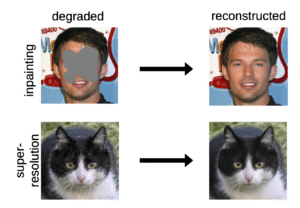
Beyond Brenier-GAN, the project produced several further contributions to generative modeling for imaging. A major result is PnP-Flow, a plug-and-play image restoration method based on flow-matching generative models. PnP-Flow uses the learned flow as an image prior and applies it efficiently to inverse problems such as denoising, deblurring, inpainting and super-resolution. The method shows how modern generative models can be integrated into classical reconstruction pipelines without relying on computationally expensive full generative sampling procedures.

The project also contributed to a better understanding of training choices in flow matching, including the influence of parametrization, loss weighting, architecture and sample complexity. These results provide practical guidance for designing generative models for real imaging tasks. Together, the outcomes extend the project’s impact beyond the original Brenier-GAN objective and demonstrate how mathematically grounded generative models can support both image synthesis and image restoration.

 
Samples from the Brenier-GAN trained on the NORB dataset.
Results of the proposed PnP-Flow method for 2 tasks of image restoration (on Celeba-HQ and AFHQ-cats).

External Website

https://segolenemartin.github.io/

Selected Publications